
- The Day Nixon Resigned: What America Looked Like in August 1974 - October 8, 2026
- 1975: The Year Punk Was Born in America - October 8, 2026
- 15 Authors Who Used a Pen Name and Outsold Their Real Byline - October 8, 2026
#16 – King Louis XV Leper Blood Bath Rumor
In May 1750, Paris heard that the king had leprosy and that agents were snatching children off the street to fill a bathtub with their blood. No cure works that way, but plenty of terrified parents believed it. Mobs turned on police officers, and the streets turned ugly fast.
The monstrous part was fiction. No evidence ties Louis XV to any such scheme. The half-true part was grimly real: authorities were cracking down on vagrants, and police were hauling off poor children, some of them not vagrants at all.
The Parisian lawyer Edmond Barbier recorded the panic in his journal, and historians such as Arlette Farge and Jacques Revel have studied it closely. Parents weren’t imagining the kidnappings. They were just wrong about the reason.
#15 – Patagonian Giants Encounter
For centuries, sailors came home with the same jaw-dropper: Patagonia was full of giants. Accounts reaching back to Magellan’s voyage, and again from British crews in the 1760s, described people eight or nine feet tall. The engravings made them look it.
The real people were the Tehuelche, and they really were tall. The tallest men the British measured came in around six feet six, and long guanaco-skin cloaks made them look even bigger.
Tall, yes. Towering over a ship’s rail, no. No giant skeleton has ever turned up. The half-true part is that Europeans had met unusually tall people, far taller than most sailors on board. The extra three feet grew in the retelling.
#14 – Warren G. Harding Racial Ancestry Claim
In the 1920s, a college professor named William Estabrook Chancellor told the country that Warren G. Harding had Black ancestry. The whisper followed the Ohio newspaperman all the way to the White House. Chancellor never produced proof, and historians have found no documents to back him up.
Meanwhile, a different rumor sounded just as scandalous, and it turned out to be true. Nan Britton claimed in her 1927 book that Harding fathered her daughter, Elizabeth Ann. In 2015, DNA testing of descendants supported her claim.
So the story the public obsessed over was the wrong one. The affair was real. The ancestry smear was a political weapon, and it says far more about the era’s prejudice than about Harding.
#13 – Vikings Greenland Iceland Name Swap
Here’s the wink-wink version: the Vikings gave Iceland a frosty name and Greenland a lush one to throw rivals off the scent of the better land. It’s a delicious story. It’s also not what the sagas say.
Norse sources say Erik the Red chose the name Greenland on purpose, because an appealing name would help him recruit settlers. That’s the half-true part. It was branding, aimed at would-be colonists rather than rivals.
Iceland’s name comes from Flóki Vilgerðarson. According to the Landnámabók, he saw a fjord clogged with drift ice and named the island accordingly. The fjords of southern Greenland do turn green in summer, so Erik wasn’t running a total bluff. No saga describes a coordinated swap.
#12 – Trojan War Historicity
For ages, scholars dismissed Homer’s ten-year siege of Troy as pure poetry. Then in the 1870s, Heinrich Schliemann began digging at Hisarlik, in what is now Turkey, and the ground started talking back. Under the mound sat a real fortified city, rebuilt again and again.
Later excavators found that one late Bronze Age layer, often called Troy VIIa, ended in fire and destruction around 1180 BCE. That’s close to the date ancient tradition gave for the war. Hittite records also mention a place called Wilusa, which many scholars link to Troy.
But the real Troy looks smaller than Homer’s epic city, and nothing proves a vast Greek coalition or meddling gods. Scholars still argue over how much memory survived in oral tradition. A real city burned. Whether Helen was the reason is another matter.
At a Glance
- Site: Hisarlik, in modern Turkey
- Digger: Heinrich Schliemann, starting in the 1870s
- Burned layer: Troy VIIa, around 1180 BCE
- Still debated: the size of the city, the Greek coalition and Helen herself
#11 – Queen of Sheba Visit to Solomon
A queen crosses the desert with camels loaded with spices and gold, just to test a king with hard questions. It’s one of the most romantic scenes in ancient storytelling. And no contemporary inscription names her.
The kingdom, though, was real. Saba, in what is now Yemen, grew rich on the incense trade, and ruins such as the great temple near Marib show a sophisticated society. That fits the caravan-and-Red-Sea commerce the story needs.
What’s missing is independent proof of the visit itself. Scholars also debate whether Saba’s peak lines up with Solomon’s era. Ethiopian tradition, in the Kebra Nagast, goes even further and says the queen’s son founded a royal line. The surviving half is the geography and the money. The meeting remains a legend.
#10 – Lady Godiva Naked Ride
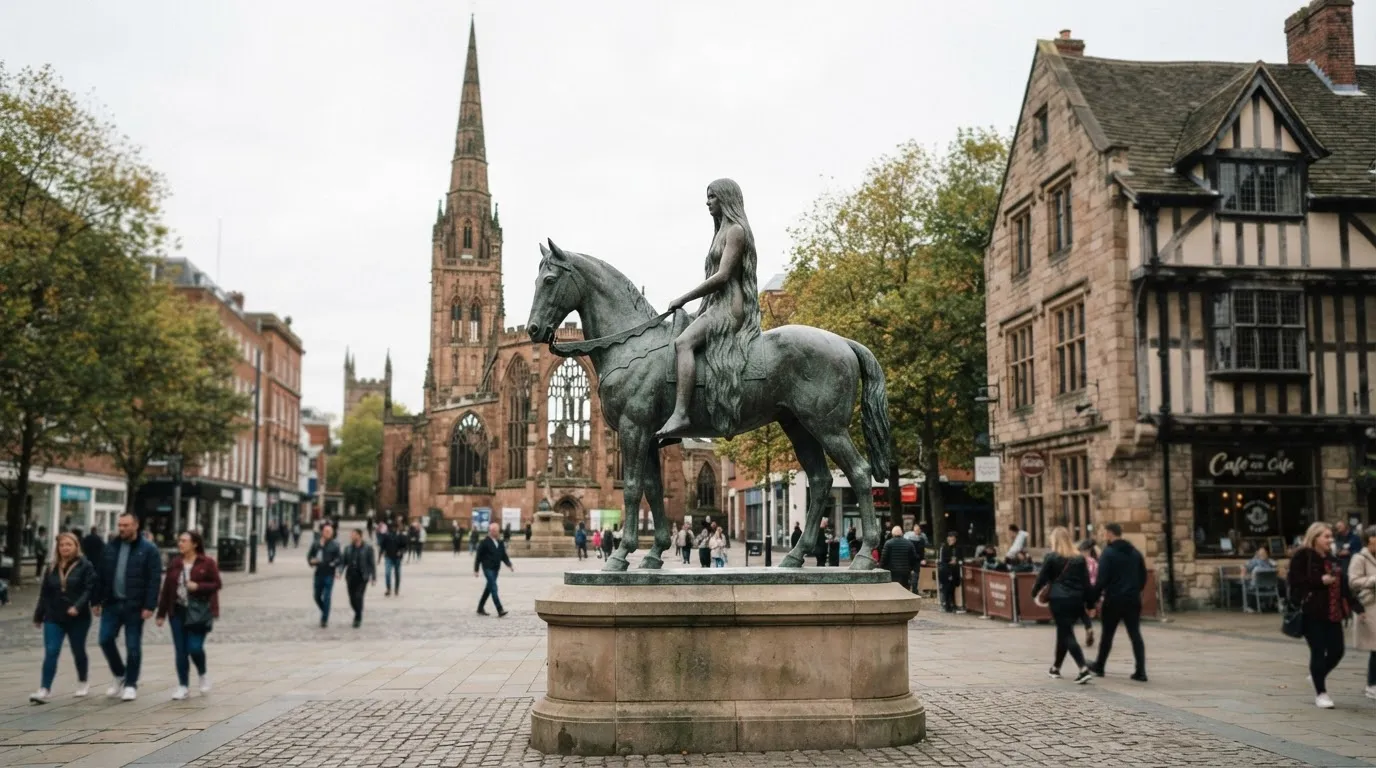
The legend is famous: a noblewoman strips, rides through Coventry on horseback and shames her husband into cutting taxes. The real Godiva would barely recognize the plot.
She did exist. Godgifu, wife of Leofric, Earl of Mercia, was a wealthy 11th-century figure who backed religious foundations, including a monastery at Coventry. She is also named in Domesday Book as a landholder from before the Conquest.
But no record from her own lifetime mentions a ride. The tale shows up in chronicles such as Roger of Wendover’s in the 13th century, roughly two centuries later. The ‘Peeping Tom’ detail came later still. Historians have floated old folk ritual or moral allegory as sources. A real woman of power, and a legend that borrowed her name.
#9 – FDR Pearl Harbor Advance Knowledge Rumor
One of America’s most durable suspicions says Franklin D. Roosevelt knew Pearl Harbor was coming and let it happen to drag a reluctant nation into war. It’s a dark idea with a long shelf life.
The half-true part is that warnings did exist. Washington sent a ‘war warning’ to Pacific commanders in late November 1941, and American codebreakers were reading Japanese diplomatic traffic.
But nobody held a clear, specific alert that Pearl Harbor would be hit on December 7. The clues were scattered across agencies and never stitched together in time. Official inquiries found failures of intelligence-sharing and judgment, not a plot. Books such as Robert Stinnett’s Day of Deceit revived the claim, but most historians reject it. America was warned about trouble in general. It wasn’t warned about this.
#8 – Paul McCartney Death Rumor
In autumn 1969, college newspapers and radio DJs convinced a generation of Beatles fans that Paul McCartney had died in a car crash in 1966 and been replaced by a lookalike. Fans spun records backward and squinted at album covers for proof.
The Abbey Road cover became Exhibit A, with barefoot Paul out of step with the others. The truth was simpler: Paul was alive and annoyed.
There was a kernel, though. He had crashed a moped in December 1965 and injured his lip. The band was also fraying, and its imagery was getting stranger. Life magazine tracked him down at his farm in Scotland and ran the headline ‘Paul is still with us.’ The rumor mistook coincidence for coded messages.
Quick Compare
- The rumor: a fatal 1966 car crash and a lookalike stand-in
- The record: a moped spill in December 1965 and an injured lip
- The rumor: album covers carried secret funeral clues
- The record: Life found him alive and well on his Scottish farm
#7 – Donation of Constantine Forgery
Imagine a document so convenient that it hands the pope power over Rome and much of the West. The Donation of Constantine claimed the emperor had granted exactly that, in thanks for his baptism. Popes cited it for centuries.
It was a forgery, probably written around the eighth century. In 1440, Lorenzo Valla showed that its Latin and terminology couldn’t belong to the fourth century.
There was a grain of truth. Constantine really did lavish favor on the Church, including property in Rome such as the Lateran. The sweeping grant of rule over the West never happened. It was a fake paper trail that helped shape real power long before anyone proved it false.
#6 – Mukden Incident Staging
On the night of September 18, 1931, a blast damaged a stretch of Japanese-controlled railway near Mukden in Manchuria. Japan’s army blamed Chinese saboteurs. Within hours, troops were on the move.
The explosion was real. The culprit story was not. Officers of Japan’s Kwantung Army set the charge themselves, and the damage was so slight that a train reportedly rolled over the track soon after. Postwar testimony and Japanese records confirmed the setup.
But the incident didn’t create the conflict. Japan already had deep economic and strategic interests in Manchuria. The staged blast was a match tossed on dry kindling. The League of Nations’ Lytton Commission later found that Japan’s actions could not be justified as self-defense.
#5 – Operation Mincemeat Deception
A British plan once relied on a dead man’s good name. In April 1943, British intelligence slipped fake Allied invasion plans into the pocket of a corpse dressed as ‘Major William Martin’ of the Royal Marines. The body was set adrift off Huelva, Spain.
Half the story was real. The body belonged to a real man, Glyndwr Michael, though his identity stayed secret until the 1990s. The major was invented, right down to a fiancée’s photo and love letters.
Spanish authorities passed the papers to the Germans, who shifted defenses toward Greece and Sardinia. The Allies landed in Sicily that July. Ewen Montagu, one of the planners, later told the tale in The Man Who Never Was. It worked because it told the enemy exactly what he already expected.
Fast Facts
- When: April 1943
- Where: the body washed ashore near Huelva, Spain
- Fake name: Major William Martin, Royal Marines
- Real man: Glyndwr Michael, named publicly decades later
- Payoff: Allied landings in Sicily that July
#4 – Piltdown Man Fossil Mix
In 1912, Charles Dawson and Arthur Smith Woodward announced a ‘missing link’ from a gravel pit at Piltdown, in Sussex. Britain finally had its own early human, and the scientific world was thrilled.
The bones were real. They just didn’t belong together. The skull was human, but the jaw came from an orangutan, and the teeth had been filed down to look worn.
In 1953, new tests exposed the fraud. Dawson is the prime suspect, but no confession ever settled the question. For roughly four decades, the find had shaped debates over human origins. It was a hoax built from genuine scientific hunger and genuine bones.
#3 – Great Moon Hoax Articles
In August 1835, New Yorkers opened the Sun and read that a famed astronomer had spotted winged man-bats, unicorns and temples on the Moon. The series ran for days, and the paper’s circulation soared.
The astronomer, Sir John Herschel, was real. He really was at the Cape of Good Hope, studying the southern sky with a large telescope. That was the believable hook.
But he had made no such discoveries. The articles, widely attributed to Sun writer Richard Adams Locke, were invented, and no telescope of the claimed power existed. They fed on a public thrilled by new instruments and eager for wonders. People weren’t foolish. They were dazzled.
#2 – Cardiff Giant Carved Statue
In October 1869, workers digging a well on a farm in Cardiff, New York, struck something enormous: a ten-foot stone man lying on his back. Crowds paid to stare, and some declared it proof of the giants in Genesis.
The giant was a gypsum statue ordered by George Hull, a tobacconist who had argued with a preacher over the Bible’s giants. The stone came from Fort Dodge, Iowa, and the figure was carved in Chicago. It was then roughed up to look ancient and buried a year before the ‘discovery.’
Hull eventually confessed. The half-true part is that it really was a stone figure that really had been underground. P.T. Barnum even made his own copy. Even the fake got a fake.
Worth Knowing
- The ‘discovery’ happened in Cardiff, New York, in October 1869.
- The figure stood about ten feet long.
- The stone came from Iowa and the carving was done in Chicago.
- Hull’s motive began with a Bible argument, then became a moneymaker.
#1 – Napoleon Height Misconception
Say ‘Napoleon complex’ and everyone pictures a pint-sized emperor stomping around in a huge hat. It may be the most famous height joke in history, and it’s built on a measuring mix-up.
Napoleon stood about five feet two inches in French units. In English inches, that’s roughly five feet six or seven, which was average or a touch above for a Frenchman of his day.
British cartoonists, James Gillray among them, drew him as ‘Little Boney,’ and the image outlived the war. The nickname ‘le petit caporal’ was affectionate, and his tall Imperial Guard may have made him look smaller by comparison. The half-true part is that he was no giant. The rest was propaganda that stuck.
CEO-Co-Founder