
- The Day Nixon Resigned: What America Looked Like in August 1974 - October 8, 2026
- 1975: The Year Punk Was Born in America - October 8, 2026
- 15 Authors Who Used a Pen Name and Outsold Their Real Byline - October 8, 2026
#16 – The Giant Eagle Float from the 2001 Rose Parade
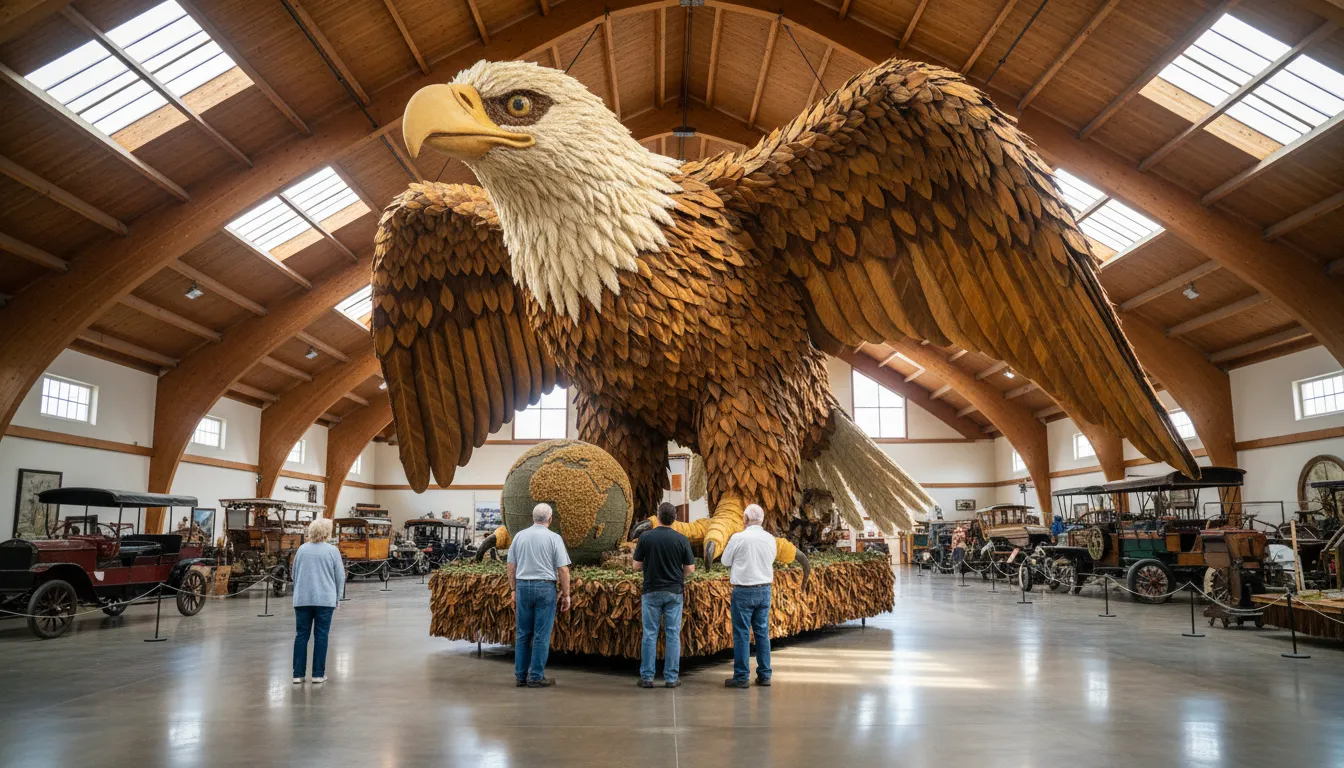
Most Rose Parade floats get one glorious morning and then get stripped for parts. This eagle got a second life in Quicksburg, Virginia, where it towers more than 29 feet over visitors at the American Celebration on Parade museum.
Tournament of Roses rules call for natural materials, so the body is covered in magnolia leaves. The head and tail use pampas grass blooms, with coconuts and coffee grounds adding texture. Earl Hargrove’s team built it for Pasadena, and Hargrove kept many of the floats he made for major events.
This one made the cut because its scale and detail were too good to dismantle. Stand close and you can still see the layered plant textures that once rolled down a Pasadena street. A parade built it for a single day, and a builder who wouldn’t let go kept it.
#15 – The American Flag Float from Reagan’s 1989 Inauguration
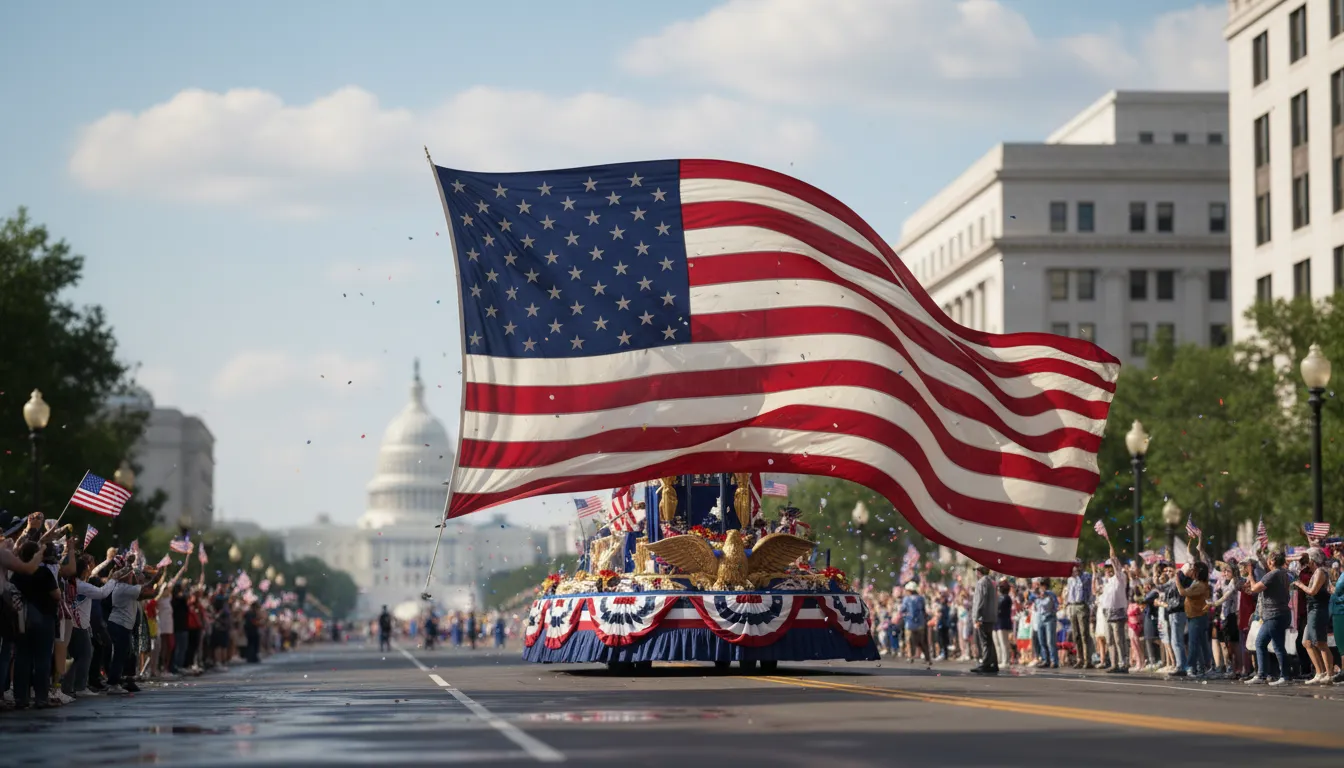
This flag is 63 feet by 24 feet and uses 5,000 square yards of crushed silk fabric. It was first prepared for Ronald Reagan’s 1985 inaugural parade, which was canceled because of dangerous cold.
So the biggest flag in the workshop sat waiting for its moment. It finally debuted at George H.W. Bush’s 1989 inaugural parade, built to wave mechanically over the route.
Fast Facts
- Size: 63 feet by 24 feet
- Fabric: 5,000 square yards of crushed silk
- 1985: Reagan’s inaugural parade canceled because of dangerous cold
- 1989: debut at George H.W. Bush’s inaugural parade
Most inaugural props vanish once the bunting comes down. Hargrove kept this one for his growing collection at Shenandoah Caverns, and the museum now shows it as a working display of the engineering behind giant parade pieces.
It is a rare case where a canceled parade and a rescheduled one both left their mark. The cold nearly erased it, and the next parade rescued it.
#14 – The Cinderella-Themed Float from a Presidential Inauguration
Picture a fairy-tale carriage rolling through a day of flags, brass bands, and political ceremony. That is the odd charm of this Cinderella float, built from Styrofoam coated in fiberglass and complete with a carriage and storybook figures.
It was made as a family-friendly moment in an inaugural parade, and Hargrove’s team delivered it. Then it did something most storybook floats never do. It went into the Virginia museum collection instead of a dumpster.
The fiberglass shell is part of the reason. Parade pieces have to survive wind, weather, and a long route, and that same toughness makes them easier to keep indoors afterward.
Today the carriage sits among other Hargrove creations. A float made for one afternoon of pageantry now works as a record of how fantasy and ceremony shared a street.
#13 – The Santa Maria Ship Float Used in Multiple Parades
Some floats do one job. This one sailed. Modeled on Columbus’s Santa Maria, the ship appeared in inaugural events, and it was built with the same durable techniques Hargrove used for presidential floats.
Its wooden-style hull and rigging details were made to read clearly from the curb, but they were also sturdy enough to be used again. A ship like that is worth more as a returning star than as a one-time prop.
That reusability is why it ended up in the Shenandoah museum. Hargrove kept examples that showed craftsmanship and versatility, and a ship that could handle repeated parade duty fit the bill.
It avoided the scrap heap that claims most one-off parade props. Hold that thought, because this same ship has another parade chapter coming up near the top of the countdown.
#12 – A Mummers String Band Costume from the Philadelphia Parade
Some costumes are so heavy they stop being clothing and start being architecture. Philadelphia’s Mummers Museum on Second Street is full of them, covered in sequins, beads, and feathers.
One fancy club frame suit can weigh up to 125 pounds. It is built on solid plywood decks and carried through the annual New Year’s Day Mummers Parade, a tradition more than a century old.
The museum holds hundreds of costumes because the parade never stopped needing new ones. Clubs compete every year, and elaborate suits get made, reworked, and saved for display.
Without that yearly procession, many of these outfits would have been discarded after one wild walk up Broad Street. Instead, the parade gave feathers and sequins a reason to become historical artifacts.
#11 – A Historic Wagon from the Tucson Rodeo Parade Museum
In Tucson, the parade is slow, loud, and proudly horse-drawn. La Fiesta de los Vaqueros Rodeo Parade is billed as the largest non-motorized parade in the United States, and it needs real wagons that still roll.
That need is why the Tucson Rodeo Parade Museum exists. It holds more than 125 horse-drawn vehicles, ranging from freight wagons and buggies to city fire vehicles.
At a Glance
- Parade: La Fiesta de los Vaqueros Rodeo Parade
- Billing: largest non-motorized parade in the U.S.
- Collection: more than 125 horse-drawn vehicles
- Range: freight wagons, buggies, and city fire vehicles
Old wagons rarely last. They rot in barns, get sold for parts, or slowly fall apart in private hands. These survived because organizers gathered them for the parade and kept them in use.
Some are still rented for the procession today. The parade does not just display history. It keeps the wheels turning.
#10 – The Shield of Parade in the British Museum
It looks like a battle shield, but it was never meant for battle. This gold-painted shield from the 1470s comes from Burgundian France or Flanders and was made for processions celebrating military victories.
Its job was to shine. In a victory parade, an ornate shield told the crowd who had won and how grand the winners wanted to look.
Shields that actually fought did not usually last. They were battered, repaired, or melted down. A shield made for show had a better chance, because noble households and later collectors had reason to keep something so decorative.
Today it sits in the British Museum’s medieval galleries. It is a weapon-shaped piece of theater that outlived the real thing.
#9 – The Veteran Pumper in the New York City Fire Museum
A fire engine that survived because it was pretty is a strange idea, but this one fits. The double-decker hand-pulled pumper was built for a Philadelphia engine company and later redecorated for the Veteran Firemen’s Association of New York City.
By then its main job was parades. It appeared in 19th-century firefighter musters and celebrations, where companies competed to show off polished, ornate machines.
The New York City Fire Museum displays it with ribbons, lanterns, and decorative plaques from those events. Together they show how much pride volunteer companies poured into public processions.
Working equipment gets worn out and replaced. A ceremonial pumper got cleaned, repainted, and admired, which is how it escaped the scrapyard.
#8 – The Steinway Hose Carriage from New York Volunteer Fire Parades
Before fire departments were full-time and uniform, volunteer companies treated parade day like a beauty contest. The Steinway hose carriage shows exactly why.
It is elaborately painted and fitted with hardware made for display, the kind of apparatus a company rolled out for July 4th and other celebrations. The New York City Fire Museum keeps it in its firefighting-on-parade exhibit.
Companies spent real money on ornate carriages because the whole neighborhood was watching. Rivalry and bragging rights turned a practical tool into a status symbol.
That status is the reason it lasted. A carriage cared for like a trophy had a far better chance of reaching a museum than a plain hose cart left out in all weather.
#7 – The PT Boat Float from Kennedy’s Inaugural Parade
John F. Kennedy’s wartime story gave his inauguration a ready-made image: a small, fast boat at sea. Hargrove built a PT Boat float to bring it to the parade route.
The boat joined other naval-themed displays in the procession. Inaugural committees wanted floats that looked accurate and impressive, and that pushed builders toward sturdy construction.
When the parade ended, this boat did not get broken down. It now sits in the Virginia parade museum among Hargrove’s archived works.
That makes it a rare kind of souvenir. It is not a letter or a photograph but a full-size piece of the pageantry that surrounded a presidency, saved because the builder knew the moment was worth keeping.
#6 – Polar Bear Floats from the 1998 Rose Parade
Here is a twist on the usual rule. These polar bears first appeared covered in flowers and seeds for the Tournament of Roses. They looked like a living garden shaped like an animal.
Flowers do not last, so the bears changed. After the parade they were re-covered in fur for museum display. The parade version was a one-day wonder, and the museum version was built to stay.
Quick Compare
- Parade version: flowers and seeds, made for the Tournament of Roses
- Museum version: re-covered in fur, made to stay on display
Hargrove’s collection includes several animal-themed pieces that once lined Pasadena streets. Their sculpted frames were made for a huge audience, which gave them a size and charm that justified saving them.
It is a quiet kind of survival, where the object keeps its shape but swaps its skin. The parade supplied the sculpture, and the museum supplied the second coat.
#5 – King Neptune’s Chariot from Rose Parade History
This chariot is part sea myth, part parade recycling project. A sea serpent pulls it, and some of its elements were reused from earlier floats, including a St. George and the dragon scene.
That is the surprise. The piece is not one parade moment but several stacked together. It appeared in multiple Rose Parades before it entered the Virginia museum.
Parade builders work on tight cycles and cannot always start from nothing. Reusing parts keeps a float affordable, and it also keeps pieces of old floats alive in new forms.
Hargrove had a habit of archiving standout creations, and this chariot carries a bit of several of them. Visitors are looking at more than one procession in a single object.
#4 – The Genie Float from the 1992 Rose Parade
Thirty feet tall, arms outstretched, and made of flowers: this genie won best design honors at the 1992 Tournament of Roses. It is the kind of float that looks like it might grant a wish to the whole street.
It was built with the same natural-material techniques as other Rose Parade entries. Then it did what few award winners get to do. It joined the Shenandoah collection.
Its pose and scale made it a natural for permanent display. Parade audiences and judges reward bold, memorable designs, and that kind of drama carries over well into a museum hall.
Hargrove chose it for the archive for exactly those qualities. The prize did not just win it a ribbon. It helped keep the genie out of the dismantling yard.
#3 – The Columbus Ship Float Rented for Thanksgiving Parades
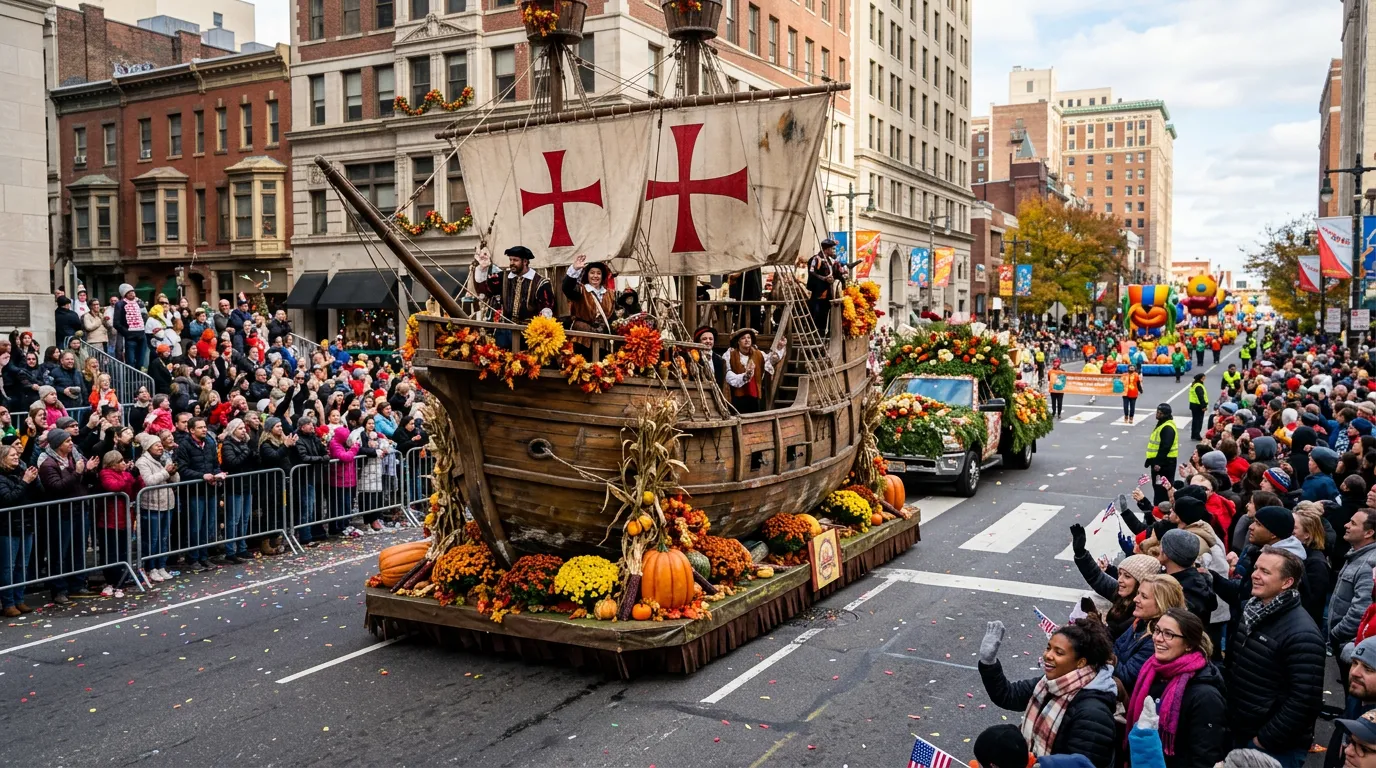
Yes, this is the same Santa Maria-style ship from earlier in the countdown, and the second half of its story is the stranger one. After inaugural duty, it sailed into Philadelphia’s Thanksgiving Day Parade when Disney rented it.
A float that goes from presidential pageantry to a holiday parade is no longer just a prop. It is a working traveler with a booking calendar, and every extra appearance was another reason not to take it apart.
Parade producers wanted reliable, thematic vehicles that could work in different cities and seasons. This ship fit that need, so it stayed intact instead of being broken down after a single route.
It now sits in the Virginia museum. Its protected status comes straight from being wanted again and again.
#2 – The Mormon Choir Float from Reagan’s Inauguration
This one was built for sound as much as sight. The 300-seat float carried the Mormon Tabernacle Choir during Ronald Reagan’s second inaugural parade.
Think about what that means. It was not a decoration with a few waving figures. It was a moving stage that had to hold a huge group of singers safely while the whole thing rolled through public streets.
Worth Knowing
- Capacity: 300 seats
- Passengers: the Mormon Tabernacle Choir
- Occasion: Reagan’s second inaugural parade
- Challenge: a moving stage carrying a full choir in public view
Hargrove engineered the platform to support the ensemble and its performance. Inaugural events demanded staging that could handle live performers in plain view of the crowd.
That robust build is part of why it stayed in the Shenandoah collection. A structure of that size, tied to a major historic day, was too substantial and too meaningful to be treated like temporary staging.
#1 – The Podium from Obama’s First Inaugural Address
The number one piece is not a float at all. It is a podium, the kind of object most people forget the moment the speech ends. This one is tied to Barack Obama’s first inaugural address.
Hargrove’s workshop produced it as part of the ceremonial setup. It now stands in the American Celebration on Parade museum, in the same halls as the eagle, the flag, and the genie.
Event furniture is usually the most disposable thing at a big public occasion. A podium tied to presidential history gets a different fate when someone decides its provenance matters.
Hargrove picked items like this for the collection because of their documented connection to national events. It exists on display because the inauguration needed a durable, presentable lectern, and someone chose to save it afterward.
CEO-Co-Founder