- 15 Hotel Breakfast Charges Guests Can Avoid by Checking the Rate Plan - October 24, 2026
- 17 Shoulder Season Travel Rules for Sudden Weather Changes - October 24, 2026
- 18 Hotel Arrival Rules That Prevent Expensive Check-In Problems - October 24, 2026
Speaking slowly in English and holding up a translation app feels like the safe move, yet for many travelers it’s exactly where the trouble starts.
The mistakes below are small enough to miss and common enough to derail a simple question, and a few of them you’d never guess you were making.
#18 – Assuming Everyone Understands Basic English Commands

Many travelers open with “Where is the station?” and assume the words will land. The listener may not know the vocabulary, but may nod politely rather than admit it.
Start with a greeting or “excuse me” in the local language instead. It signals respect and often invites the listener to try another shared language or a gesture. Then repeat your question in very basic terms.
#17 – Relying Solely on a Translation App Without Context
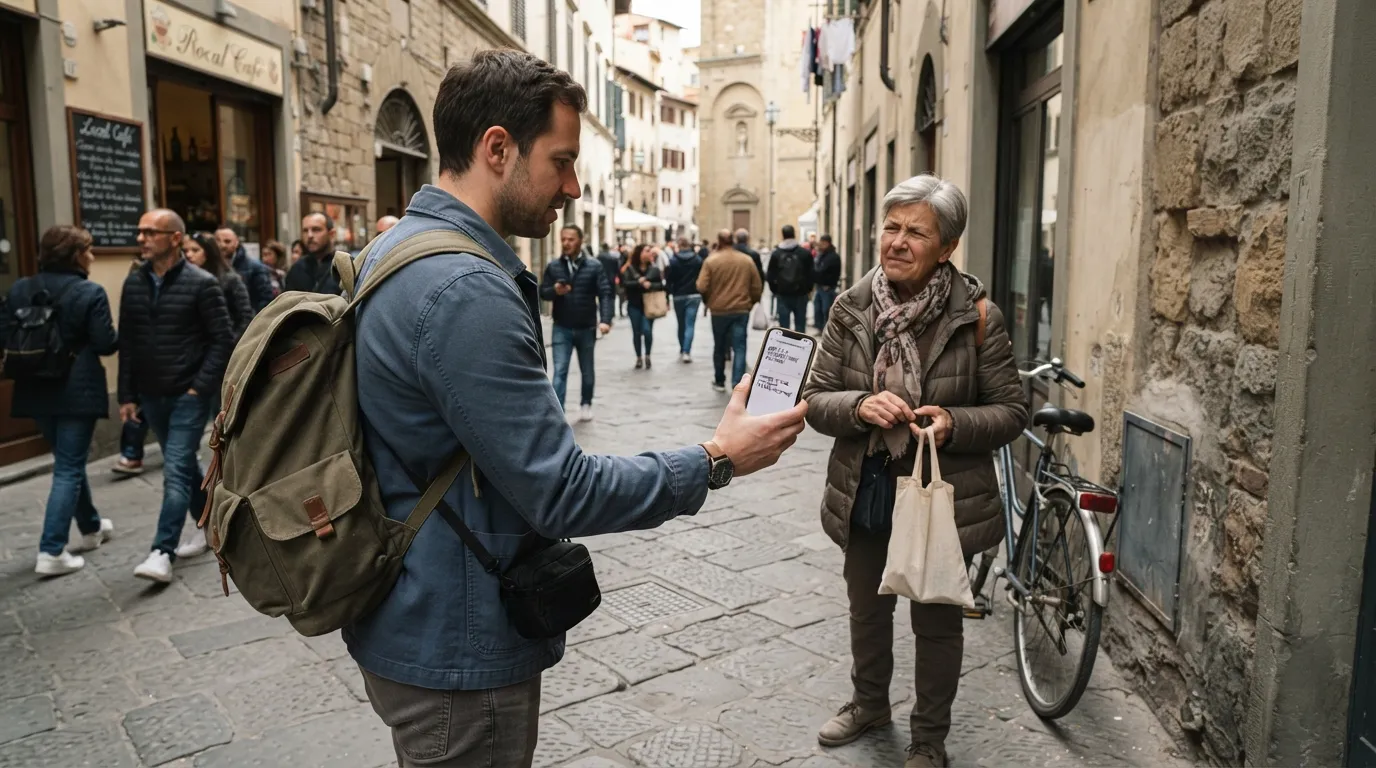
Translation apps often deliver literal results that miss tone, formality, and regional phrasing. What comes out can sound oddly blunt, and the listener may answer with a puzzled look or a half-answer.
Pair the app with a short local phrase for “can you help me?” Then read the translation back slowly before you speak, so you can catch obvious errors.
The next mistake happens before you even finish your sentence.
#16 – Stacking Three Questions Into One Breath

“Sorry, do you know where the museum is, and is it far, and can I walk?” That’s three questions at once, and each one is another place to get lost in a second language.
Ask one thing at a time. Say the place name, then “where?” Wait for the answer before asking about distance or time.
#15 – Saying a Place Name the Way It Looks on Paper
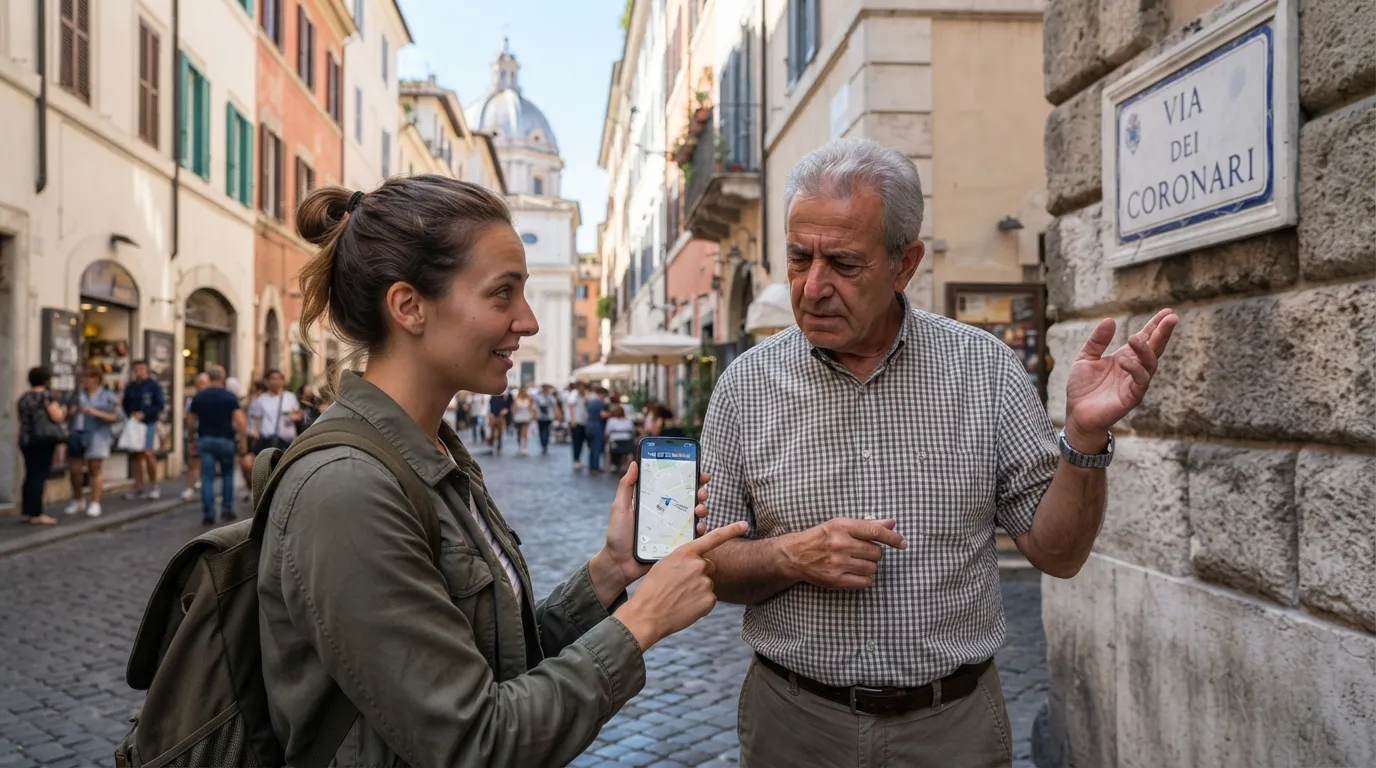
Spelling and pronunciation often part ways, especially for street and station names. A name that looks easy on your screen can sound unrecognizable when you say it aloud.
Say it once as best you can, then show it written on your phone or a map. Letting the listener read the name removes the guesswork for both of you.
#14 – Using Idioms and Slang That Don’t Travel
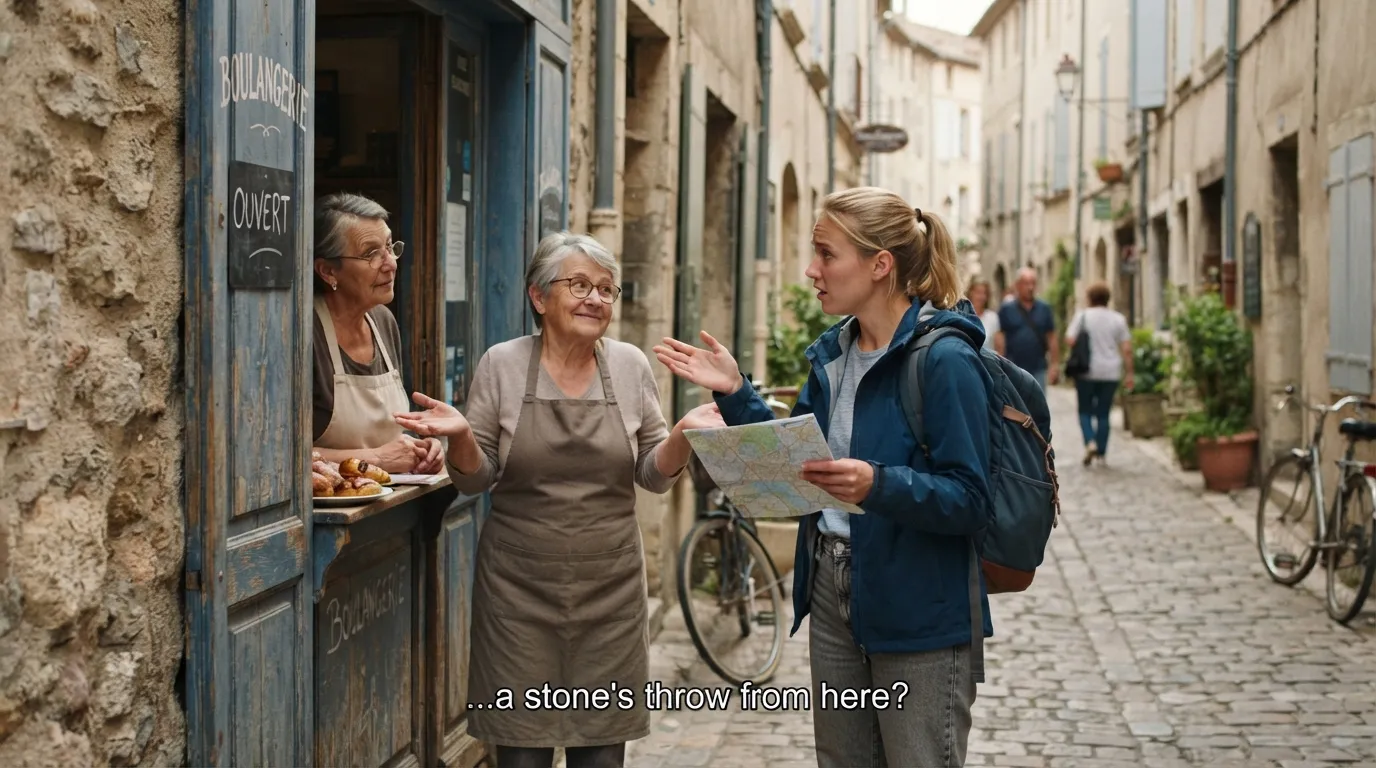
“Is it a stone’s throw from here?” makes sense at home. Abroad, it can sound like a puzzle about stones.
Idioms rarely translate, and even a fluent English speaker may stumble on them. Swap them for plain words like “Is it near?” or “Is it far?” Short and simple is far easier to answer.
#13 – Asking Only Yes-or-No Questions
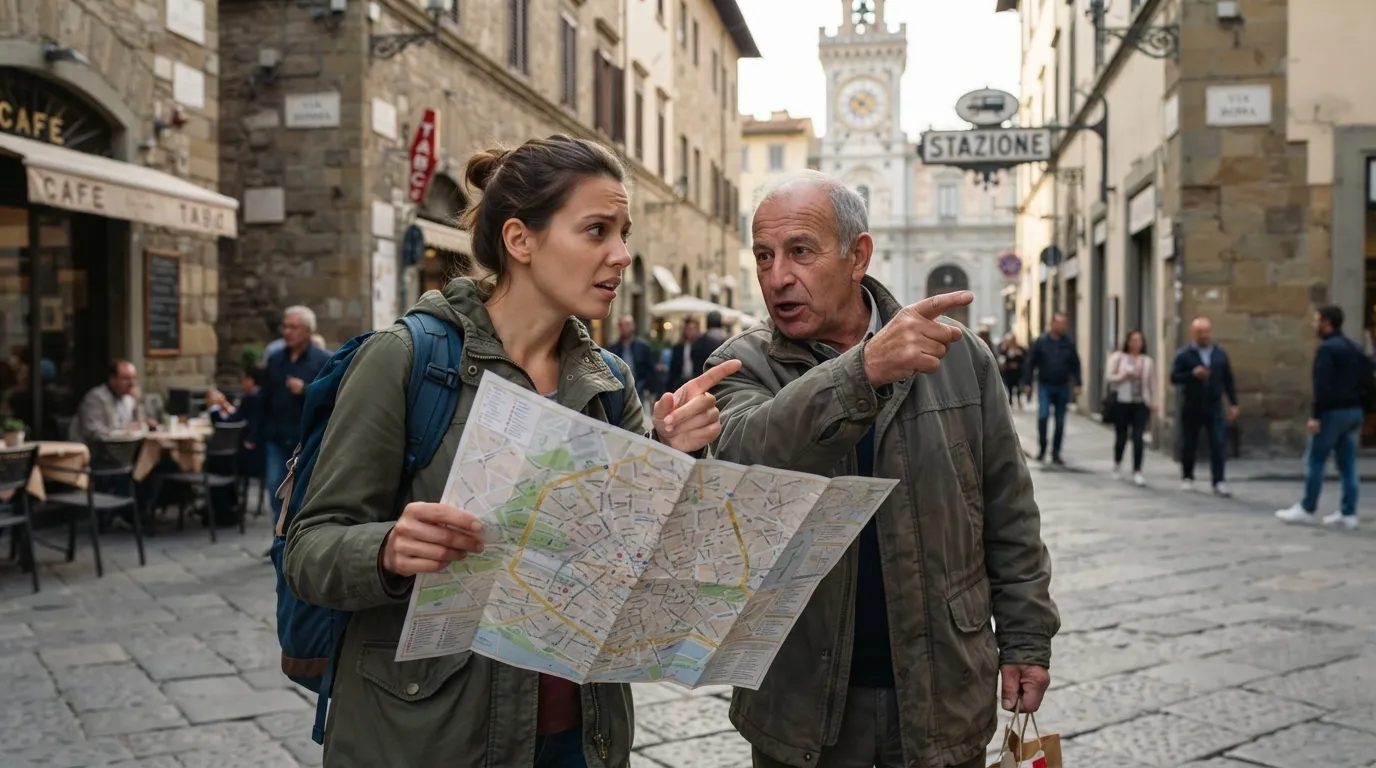
“Is the station this way?” invites a quick “yes,” and that yes may simply be the one word the listener caught, or a friendly attempt to help.
Ask an open question instead: “Which way is the station?” Then let them point or trace the route on your map. The answer will tell you far more than a nod.
Quick Compare
- Closed: “Is the station this way?” A nod could mean anything.
- Open: “Which way is the station?” You get a direction to follow.
- Best of both: Ask open, then confirm with “This way?” while pointing.
#12 – Repeating the Same Words, Only Louder
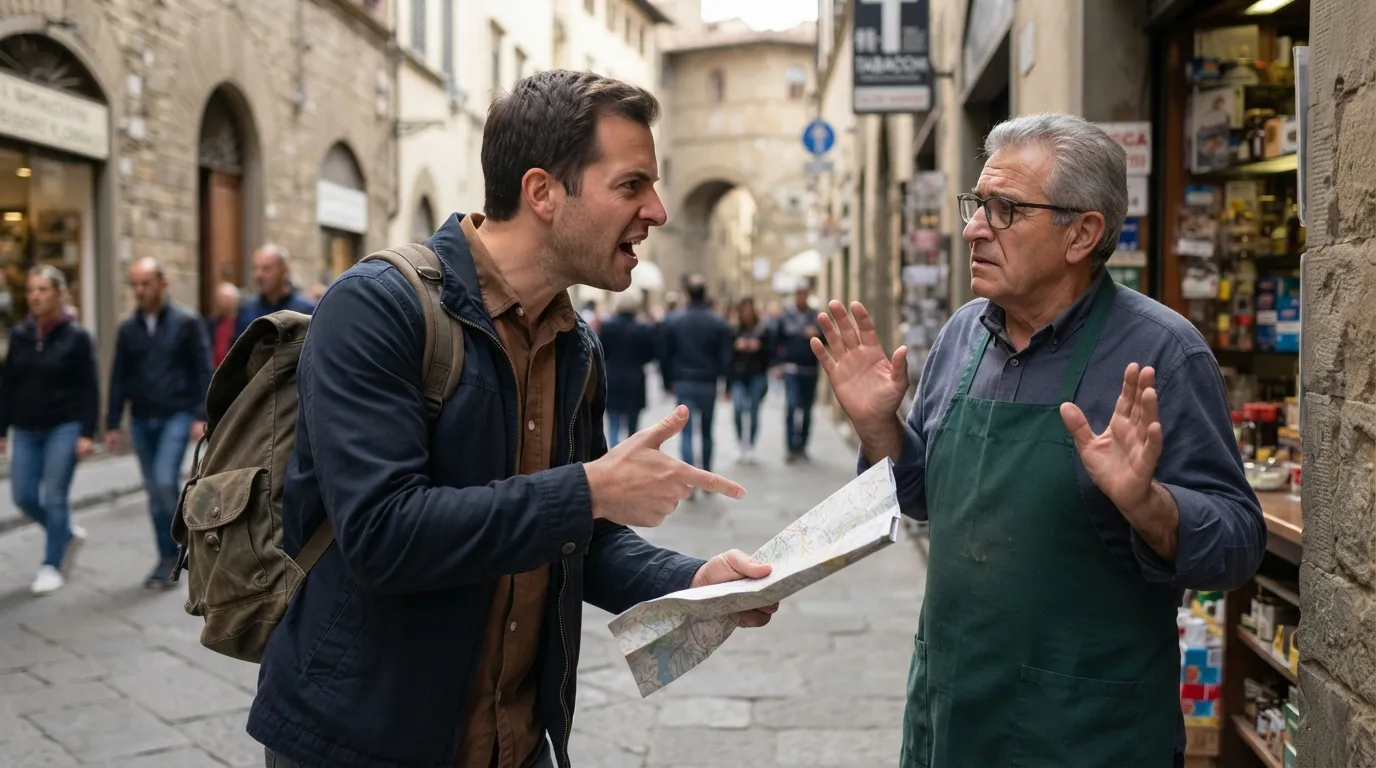
When someone looks confused, volume feels like help. It isn’t, because louder words are still the same words, and they can come across as scolding.
Rephrase with simpler words, slow down, and keep your tone calm. A map or a photo of your destination can carry the meaning when your voice can’t.
#11 – Assuming Gestures Mean the Same Everywhere

Pointing, beckoning, the thumbs-up, and the “OK” sign can carry different meanings from one place to another. A gesture meant to be friendly might land awkwardly, or not at all.
Watch how locals gesture when they talk. When in doubt, hold out your phone and ask them to show you the route on the map.
#10 – Listening Only for Street Names
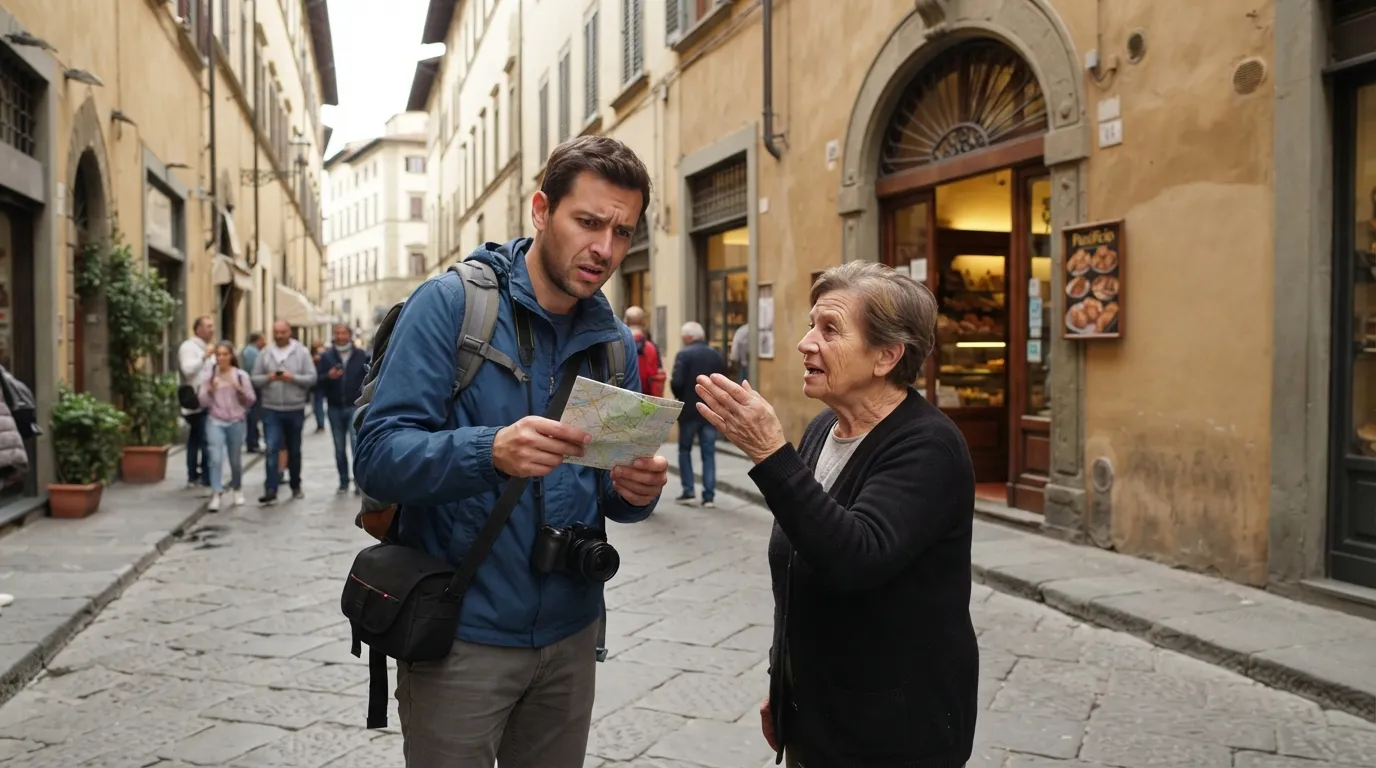
In some places, people give directions by landmarks, like a bakery, a bridge, or a big intersection, rather than by street names. If you wait for a name that never comes, you may miss a perfectly good answer.
Ask, “What should I look for along the way?” Then note those landmarks on your map as they’re mentioned.
Up next: a number problem that has sent many travelers the wrong way.
#9 – Mixing Up Distance Units

Asking “How many miles?” in a country that measures in kilometers can lead to an answer you can’t picture. “Ten minutes” and “two kilometers” feel very different when you’re tired and carrying a bag.
Ask about time instead: “How many minutes on foot?” A time-based answer is easier to compare, whatever unit the speaker normally uses.
Fast Facts
- 1 mile is about 1.6 kilometers.
- 1 kilometer is about 0.6 miles.
- A relaxed walking pace is often estimated at around 5 km/h, or roughly 3 mph.
- At that pace, 10 minutes on foot is a little under a kilometer.
#8 – Nodding Along Without Confirming
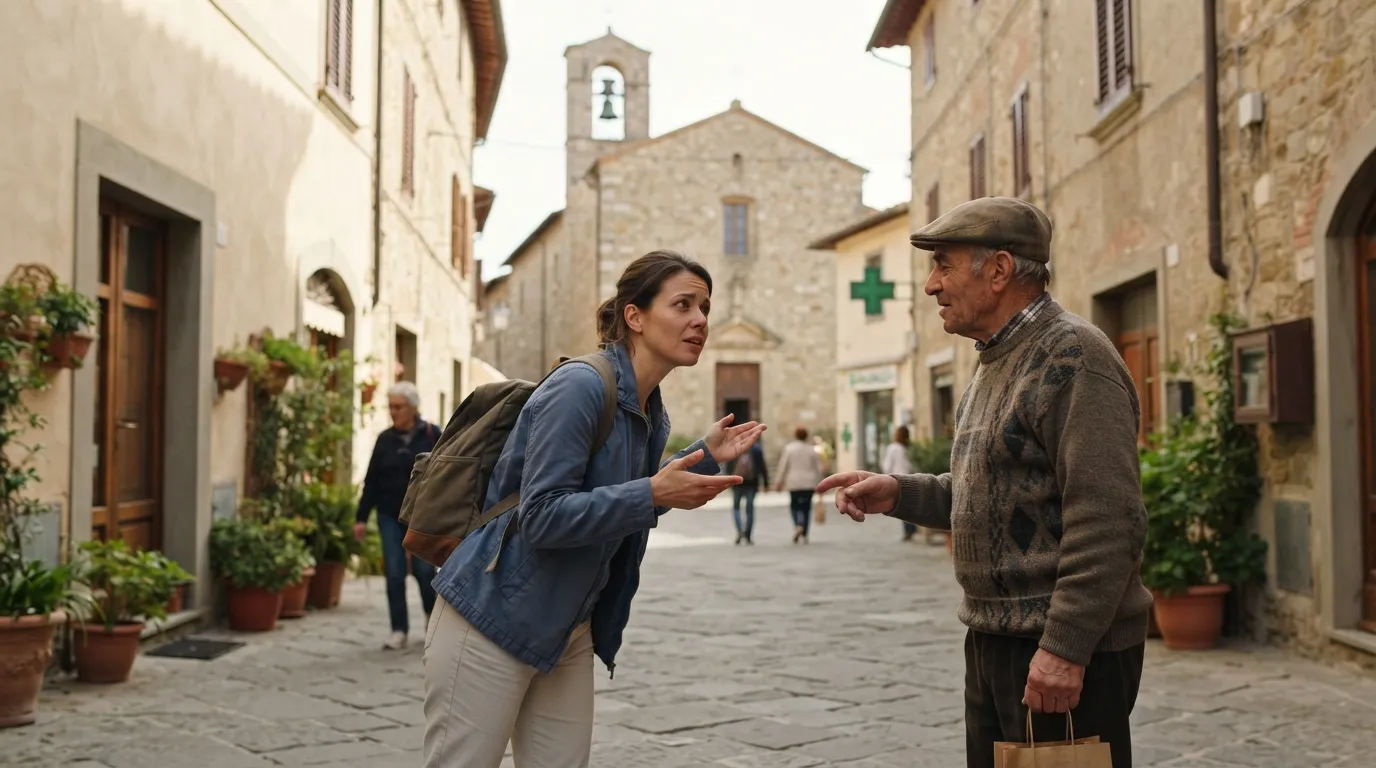
Directions often come as a chain: straight, then left, then right after the pharmacy. Miss one link and the whole route breaks, but a polite nod makes it look like you got it all.
Repeat the key steps back: “Straight, then left at the church?” This gives the person an easy chance to correct you before you walk off.
#7 – Forgetting to Say How You’re Traveling

The best route on foot is rarely the best route by bus, subway, or car. If you don’t say how you’re getting there, the listener may describe a route that doesn’t work for you.
Say it up front, using “on foot,” “by bus,” or “by car” in the local language if you can. A quick gesture or a transit icon on your phone can fill the gap.
#6 – Stopping Someone Mid-Stride

A person hurrying past with a phone to their ear may only have time for a rushed point, which is hard to follow in any language.
Try a pause that’s natural, like someone standing in a doorway or waiting at a crossing. Shops, hotel desks, and information counters also work well, since helping is part of the setting. A simple “Do you have a moment?” goes a long way.
#5 – Giving Orders Instead of Making Requests
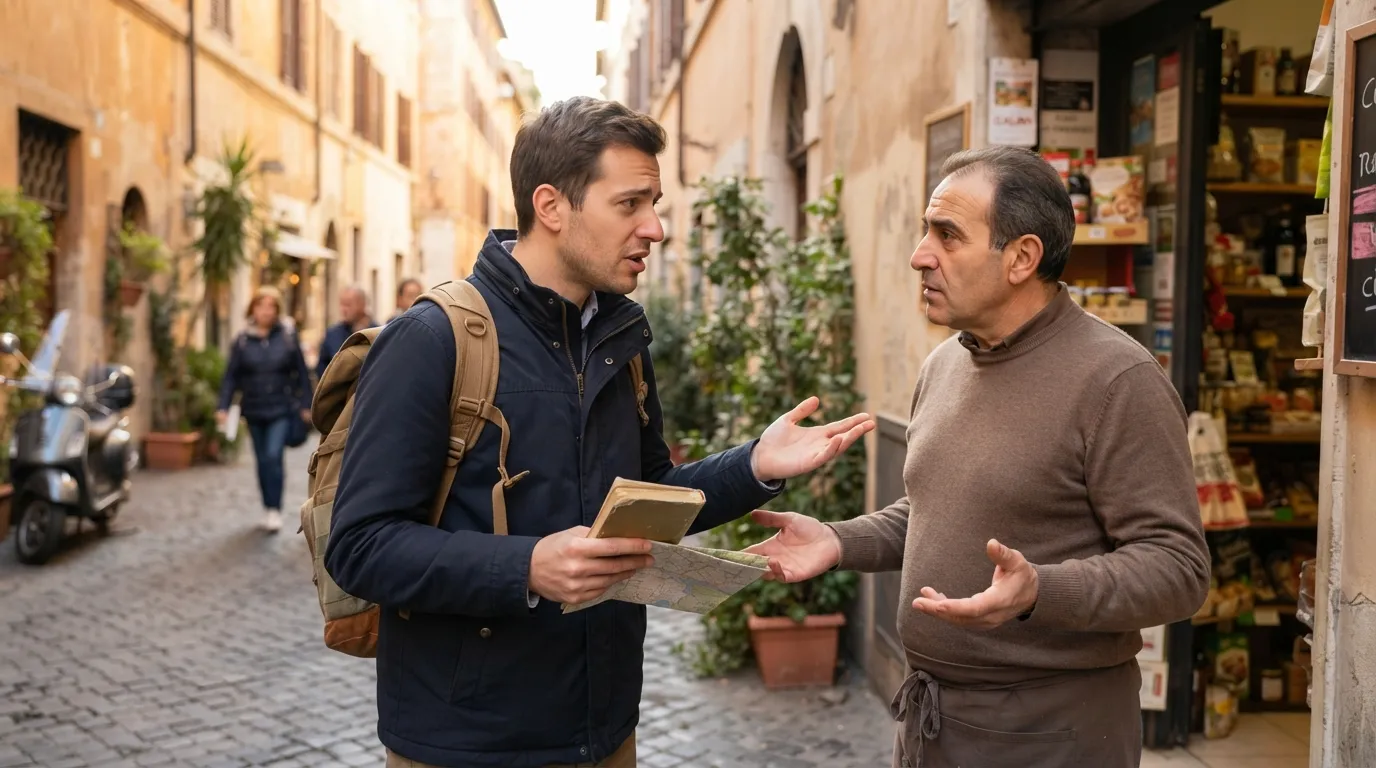
“Tell me where the hotel is” may sound harmless in English. Translated word for word, it can come across as a command.
Many languages have polite forms and distinct levels of formality. Frame your question as a request, such as “Could you please help me?” If a phrasebook offers a polite option, choose it. Courtesy often gets you slower, clearer, friendlier directions.
#4 – Treating the First Answer as the Final One

Someone who isn’t sure may still point in a general direction, simply because they want to be helpful. It’s a very human reaction, but it can send you several blocks the wrong way.
If the answer sounds vague, ask a second person or confirm with your map after a few minutes of walking. Two matching answers are worth far more than one confident-looking point.
#3 – Learning to Ask, but Not to Understand

Phrasebooks are great at questions. The reply is what trips people up, arriving fast and full of words you never practiced.
Spend a little time on the answer side: left, right, straight ahead, corner, and a few numbers. Add “more slowly, please” and “could you write it down?” A few listening words can matter as much as the perfect question.
At a Glance
- Directions to catch: left, right, straight ahead.
- Place words: corner, bridge, crossing.
- Numbers: at least the first ten.
- Lifesavers: “more slowly, please” and “could you write it down?”
The last two mistakes are the ones almost everyone makes without noticing.
#2 – Assuming Floors and Buildings Are Counted Like Home

In some countries, the “first floor” is the ground level. In others, it’s the level above. Hear “first floor” in the wrong country and you could end up one staircase away from where you need to be.
Ask a clarifying question such as “Ground level, or up the stairs?” You can also ask how many flights of stairs to climb.
#1 – Leaving Without a Proper Thank-You

When the directions are done, it’s tempting to hurry off, phone already in hand. But a missing thank-you leaves the exchange feeling unfinished, and it’s one of the easiest things to fix.
Learn “thank you” in the local language and say it with a smile. Better yet, repeat the main step one last time as you thank them. Clear directions rarely depend on perfect grammar. They come from making it easy for someone to help you.
CEO-Co-Founder