
- The Day Nixon Resigned: What America Looked Like in August 1974 - October 8, 2026
- 1975: The Year Punk Was Born in America - October 8, 2026
- 15 Authors Who Used a Pen Name and Outsold Their Real Byline - October 8, 2026
#13 – Penny Lane’s Fur-Trimmed Coat in Almost Famous
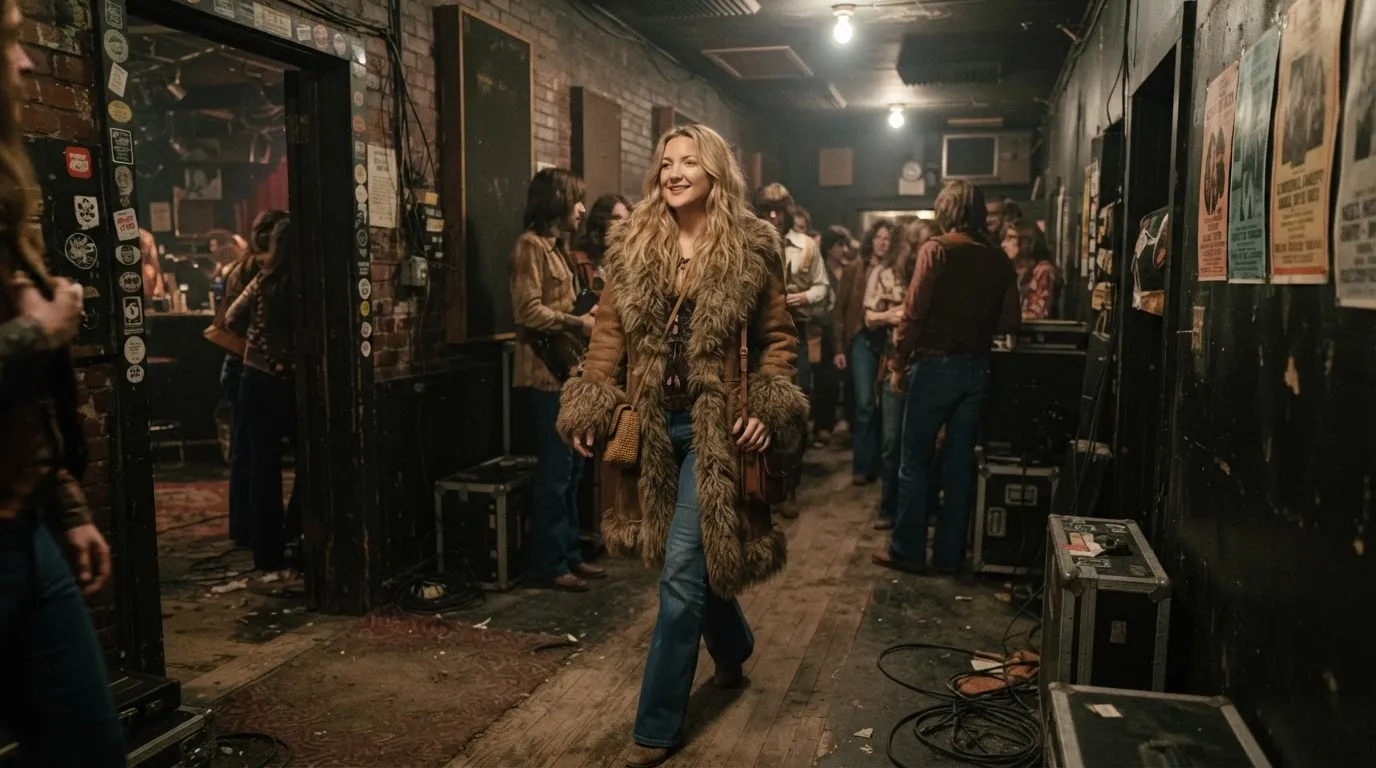
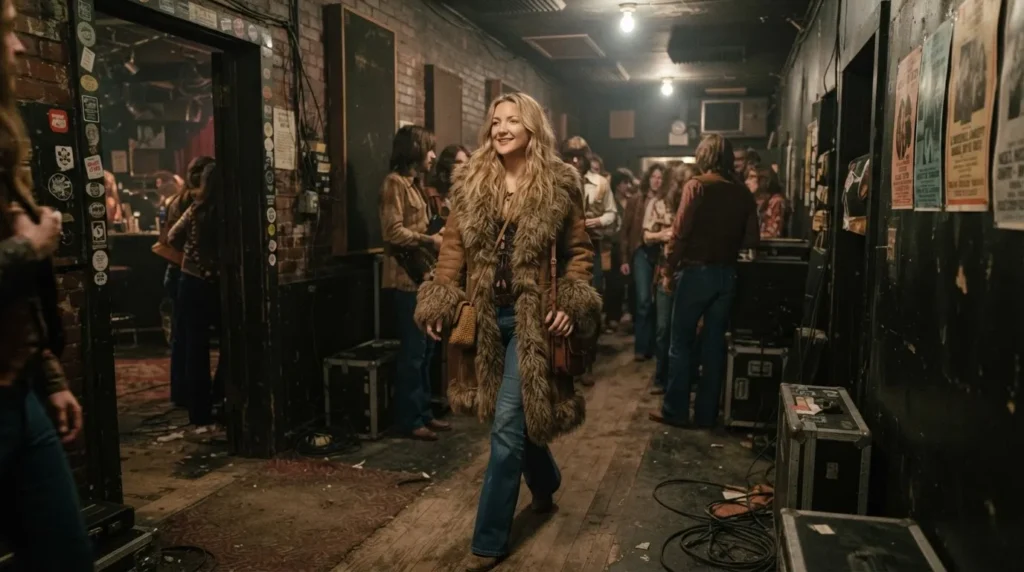
The most famous coat in rock-movie history looks like pure costume. It also looks like something a real fan could have dragged through a muddy field.
In Almost Famous (2000), Kate Hudson’s Penny Lane sweeps through backstage hallways in a shaggy, fur-trimmed coat that became shorthand for the 1970s band-aid. Costume designer Betsy Heimann dressed the film in the look of early-’70s rock culture, and the silhouette matches what crowds really wore: oversized outerwear thrown over thin layers, with boots underneath.
Photos of late-’60s and early-’70s rock crowds are full of the same formula. Big coats, blankets, and boots covered summer clothes when the night turned cold or the ground turned to mud.
That’s why the coat works as both armor and statement. It says she belongs to the scene, and it says she got there before anyone invited her.
Keep going. The further down this list you travel, the less these outfits feel invented, and the more they feel like someone’s real weekend.
#12 – Dani’s Flower Dress in Midsommar
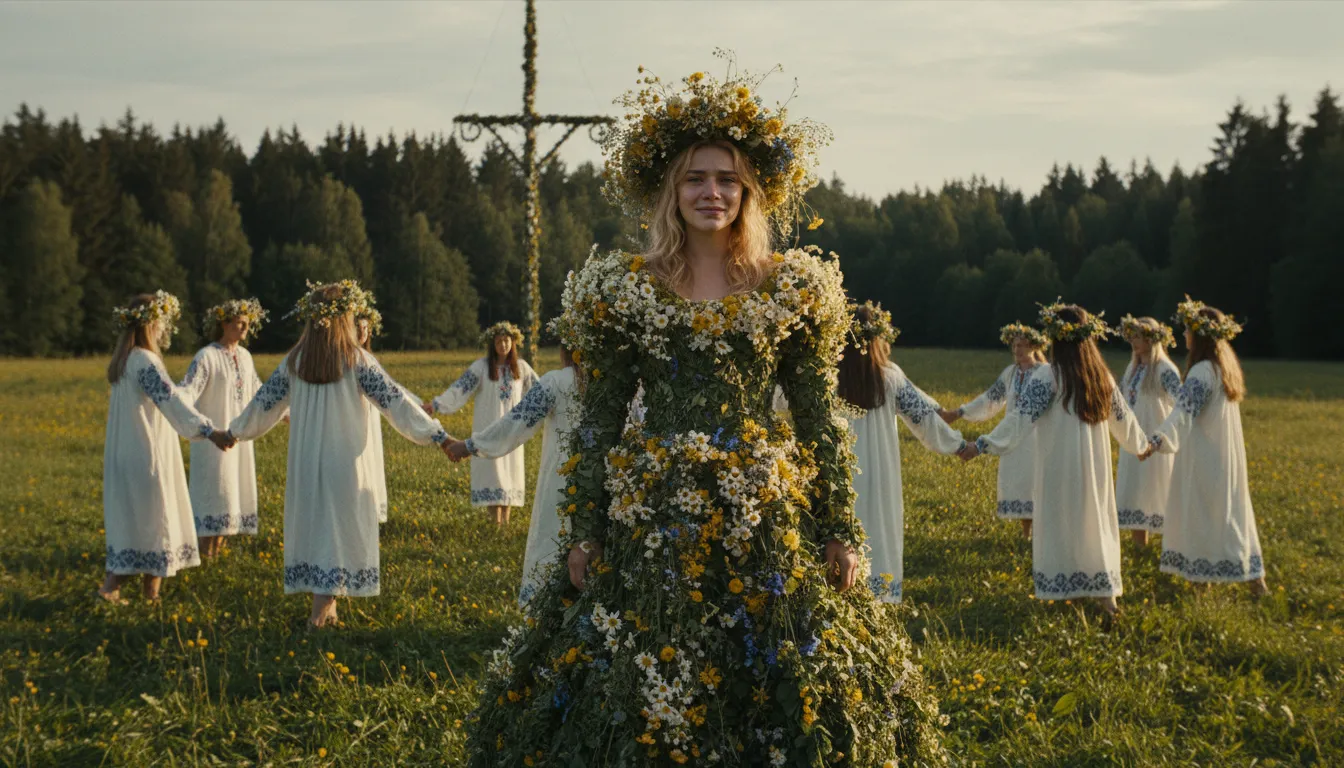
The most unsettling outfit in Midsommar (2019) is also the prettiest. Florence Pugh’s Dani is crowned May Queen in a towering dress made of fresh flowers, and the image is hard to shake.
Ari Aster set the film in the fictional Hårga community in Sweden. Costume designer Andrea Flesch drew on Swedish folk dress and midsummer imagery: white embroidered garments, and flowers worked into clothing and hair.
Flower wreaths are a genuine part of Swedish midsummer celebrations, when people gather to raise a maypole, dance, and wear greenery on their heads. That’s the trick. A flower crown at a summer gathering is a charming tradition. Put a whole village in matching white and blooms, and it starts to look like a uniform.
Fresh flowers are also a ticking clock. They wilt, shed petals, and need replacing, which is why real midsummer wreaths feel tied to one fleeting day. The film borrows that fragility and turns it into dread.
#11 – The Stillsuits and Desert Robes of Dune
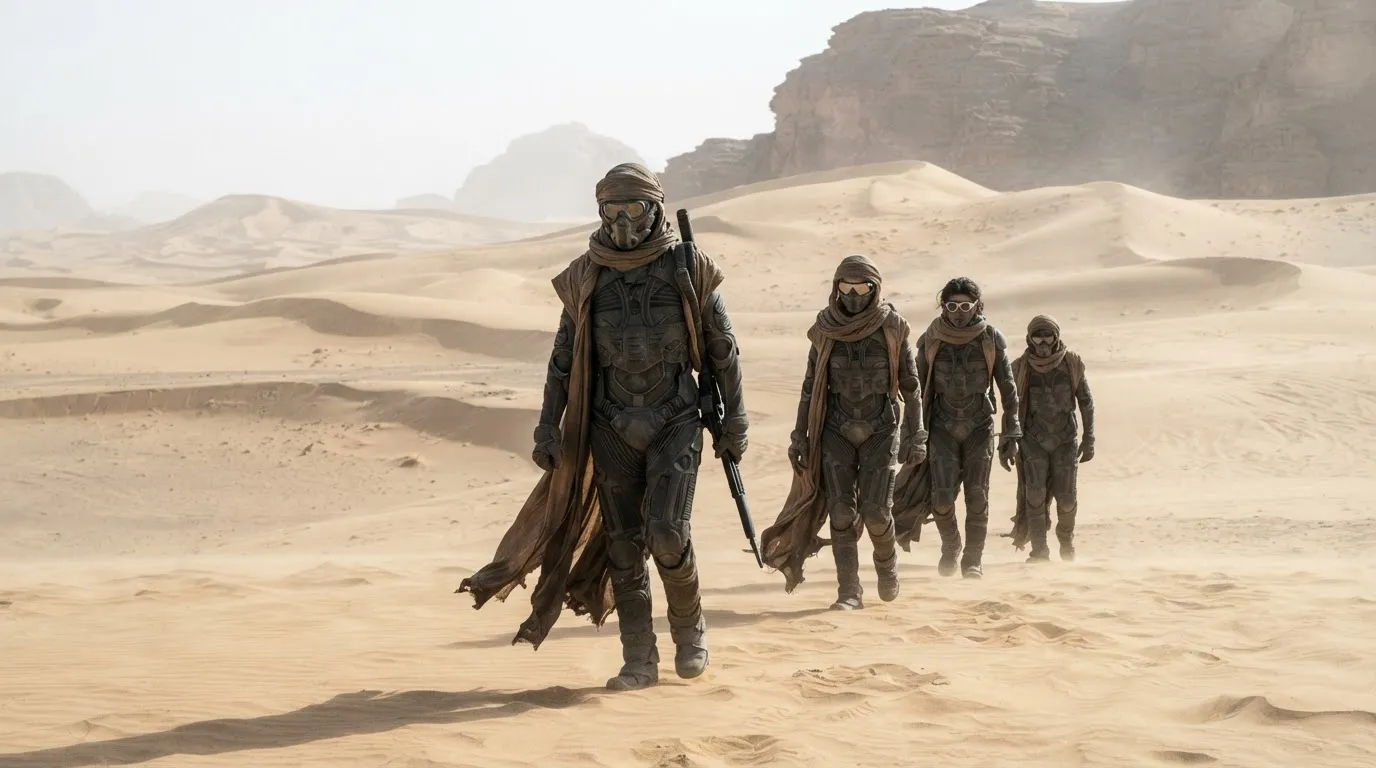
A desert is a brutal costume designer. Sun, wind, and fine dust force the same answers again and again: cover the skin, wrap the face, layer loose fabric.
Denis Villeneuve’s Dune (2021) pushes that logic to the extreme. Costume designers Jacqueline West and Bob Morgan gave the Fremen stillsuits, which in the story recycle the body’s moisture, plus flowing robes and wraps over them.
Quick Compare
- Dune: robes and face wraps built for a hostile planet.
- Burning Man: scarves, goggles, and dust masks built for blowing playa dust.
- Shared logic: loose layers, covered faces, and nothing there just for show.
Nothing says the film’s team copied a festival outfit. But anyone who has seen photos of Burning Man in Nevada’s Black Rock Desert will spot the family resemblance.
That overlap is the fascinating part. Both wardrobes look related because they answer the same problem. Loose cuts let air move, and wraps keep grit out of the mouth and nose.
The result is a planet that looks lived-in rather than polished. Festival veterans may feel a flicker of recognition during the sandstorm scenes.
#10 – Anne Hathaway’s Festival Looks in The Idea of You
Festival fashion moves fast, and The Idea of You (2024) knows it. When Anne Hathaway’s Solène follows pop star Hayes into the world of Coachella, the clothes do half the storytelling.
Coachella has been held at the Empire Polo Club in Indio, California, for decades, and its style has become its own genre. The film’s festival sequence taps the familiar vocabulary: crop tops, fringe, wide-brim hats, boots, and stacked accessories that look right under a desert sun.
Anyone who has scrolled through years of Coachella photos will recognize the pieces. They aren’t futuristic or exaggerated. They feel like the ones people actually pack, then regret or adore by hour six.
That’s where the scene earns its realism. A festival is one of the few places where a famous musician, a fan, and a first-timer can all end up in versions of the same outfit.
The film treats those clothes as a living reference, not set dressing. It makes the world feel less staged and more scrolled-through.
#9 – The Tie-Dye Swirls of Taking Woodstock
Few patterns are as welded to one weekend as tie-dye is to Woodstock. Say the word, and you can almost see the blurry swirls of a field in 1969.
Ang Lee’s Taking Woodstock (2009) tells the story of how the festival landed in Bethel, New York, through the eyes of Elliot Tiber, played by Demetri Martin. The crowd scenes fill the frame with the era’s hand-dyed look.
Tie-dye caught on among counterculture crowds in the late 1960s because it was cheap, personal, and a little rebellious. You could make it at home with fabric dye, rubber bands, and patience. No two shirts came out alike.
That’s why the detail matters on screen. Uniform patterns would look like a costume rack. The wobbly, uneven versions look like someone’s kitchen-sink Saturday.
Compare film frames to photographs of the real Woodstock crowd, and the match is part of the pleasure. The shirts say the festival was a place where people showed up wearing their own handiwork.
#8 – The Fringed Jackets of Almost Famous and Hendrix at Woodstock
Fringe has a stage trick that sequins can’t match. It moves a half-second after you do, and the audience sees every swing from the back row.
Jimi Hendrix’s famous Woodstock set in 1969 came with a white fringed jacket and a headband. The image is still burned into festival history.
Fast Facts
- Woodstock ran August 15 to 18, 1969, in Bethel, New York.
- Hendrix played the closing set on the final morning, Monday, August 18.
- Almost Famous (2000) was written and directed by Cameron Crowe.
- Stillwater, the band in the film, is fictional.
Almost Famous leans into the same visual language. Suede, leather, and fringe turn up in Stillwater’s stage looks, nodding to the Western-flavored side of that era.
It isn’t a one-to-one copy of any outfit. It’s a borrowed silhouette, and that’s why it works so quietly. Someone who has seen the Hendrix photographs gets a small jolt of recognition without needing it explained.
The fringe also does what it did for real performers: it makes motion visible from a distance. A guitarist swinging an arm becomes a small storm of suede under the lights.
#7 – The Crochet and Handmade Looks of A Walk on the Moon
A Walk on the Moon (1999) isn’t set at a festival, exactly. It’s about what happens when a festival lands next door.
The film follows a family at a Catskills bungalow colony in the summer of 1969, as Woodstock draws the counterculture closer. Diane Lane’s Pearl drifts from housewife routines toward something freer, and the clothes help mark that drift. Even Viggo Mortensen’s character fits the theme, since he’s a traveling blouse salesman.
Open-weave crochet and other handmade textures were part of the late-’60s wardrobe seen at gatherings like Woodstock. They were breathable for summer, easy to layer, and personal in a way store-bought clothes weren’t.
On screen, those soft, loose textures contrast with the tidy, structured clothes of the older generation. The costumes make the culture clash visible before anyone says a line.
The best period costuming doesn’t announce itself. It just makes the year feel believable.
#6 – The Floppy Hats of the Woodstock Crowd Scenes
Zoom into any wide shot of the 1969 Woodstock crowd, and the heads tell their own story. Brimmed hats, bandanas, and headbands dot the field like punctuation.
Roughly 400,000 people reportedly came to that farm in Bethel, New York, and many were outdoors for days. A floppy hat was the cheapest sunscreen on the grounds.
It was also a signature. In a sea of strangers, a hat became a way to recognize your friends across a field.
Films that revisit the festival, including Taking Woodstock, borrow that visual shorthand. The brims in the crowd shots help the frame look like the photographs people remember.
It’s a small detail, but it explains why period crowd scenes work when they work. A costume department doesn’t need every extra in a headline outfit. A few dozen well-placed hats tell your eye it’s the right summer.
#5 – Rey’s Wrapped Layers on Jakku in The Force Awakens
Before she touches a lightsaber, Rey is dressed like someone who survives a desert for a living. That’s what makes her first look so memorable.
In Star Wars: The Force Awakens (2015), costume designer Michael Kaplan gave her layered, wrapped fabrics in sandy tones, with arm wraps and goggles. The scavenger planet Jakku calls for clothes that protect and last.
No one claims the look was copied from a festival. But anyone who has seen playa photographs from Burning Man will recognize the cousin: layered scarves, wraps, and eyewear for places where dust gets everywhere.
That’s the secret behind a lot of festival-meets-film style. The desert sets the rules, so the clothes end up rhyming.
Wrapped layers are also forgiving. They can be loosened in the heat, tightened in the wind, and pulled over the face when the air turns gritty. On screen, they make Rey look resourceful before she says a word.
#4 – The Embroidered Folk Looks of Wonderwall
Wonderwall (1968) is a psychedelic London fantasy, not a festival film. That’s exactly why it belongs on this list.
In the movie, Jane Birkin plays the young woman next door, glimpsed through a hole in the wall by a lonely professor. The film’s late-’60s look is full of the bohemian handwork that defined the counterculture: folk-inspired embroidery, rich color, and clothes that look stitched rather than bought.
Festival crowds of the era wore much the same mix. Hand-embroidered details turned a plain dress or jacket into a one-of-a-kind piece, and a field full of them looked like a moving quilt.
That’s the hidden lesson. Festival style didn’t start at the festival. It drifted in from the streets, the markets, and the craft tables of a whole generation.
Embroidery also photographs beautifully in outdoor light. Thread catches the sun, patterns pop, and the handmade quality survives even in grainy film.
#3 – Jackson Maine’s Stage Look in A Star Is Born
Sometimes the best way to copy a real festival is to film inside one. A Star Is Born (2018) did exactly that.
Bradley Cooper shot concert scenes in front of real crowds at Coachella and Glastonbury in 2017. That means the frame behind Jackson Maine is packed with actual festival-goers in whatever they’d put on that morning.
At a Glance
- Bradley Cooper directed the film and plays Jackson Maine.
- Lady Gaga stars opposite him as Ally.
- Real festival footage came from Coachella in California and Glastonbury in England.
- The crowds were genuine, so their outfits were too.
The effect is startling. No wardrobe department could mass-produce the mix of sunburnt shoulders, mismatched jackets, glitter, and thrift-store boots that real crowds wear.
Jackson’s own look leans toward worn-in, road-weathered Americana-rock stage clothes. Next to the genuine crowd, it feels less like a costume and more like a lived-in uniform.
It’s a clever blend. The film makes the star’s outfit feel real by surrounding it with real outfits that nobody planned.
#2 – The Goggles and Dust Gear of Mad Max: Fury Road
Mad Max: Fury Road (2015) is a chase through a wasteland, but parts of it look like the world’s wildest festival parking lot. A guitarist strapped to a wall of speakers on a truck doesn’t hurt the comparison.
Jenny Beavan won the Oscar for costume design on the film, and its wardrobe is a masterclass in scavenged utility. Goggles, masks, wraps, and patched-together layers fill the frame.
There’s no evidence the designers copied a particular festival outfit. But anyone who has seen Burning Man photographs will see the overlap. Goggles and dust masks are everyday gear on the playa, where wind can turn the air into a gritty haze.
Both worlds reach the same answer because protective gear is protective gear. Eyes need shields, mouths need filters, and the look follows the function.
That’s why the film’s costumes feel strangely familiar. The apocalypse, it turns out, shares a closet with a desert party.
#1 – Freddie Mercury’s Live Aid Outfit in Bohemian Rhapsody
This is the one that isn’t a hint or an echo. It’s a deliberate copy of a real festival-scale moment.
On July 13, 1985, Queen played Live Aid at Wembley Stadium in London, part of a vast benefit concert that also ran in Philadelphia. Freddie Mercury walked on in a white tank top and light jeans, with a moustache and a studded wristband, and a set of roughly twenty minutes became legend.
Why It Stands Out
- It matches a date you can look up: July 13, 1985.
- The real footage exists, so every detail can be checked.
- The outfit is a plain tank, jeans, and a wristband.
- The film’s version, from 2018, leans on that exact simplicity.
Bohemian Rhapsody recreates that look with striking precision. Rami Malek wears the same plain-but-iconic combination, and costume designer Julian Day shaped the film’s wardrobe around real photographs and footage.
What makes it work is how ordinary the clothes are. There are no sequins, no capes, and no glitter. Just a tank, jeans, and an unmistakable presence.
Most costume work asks you to believe. This one invites you to compare, and the match is the whole thrill.
CEO-Co-Founder