- The Day Nixon Resigned: What America Looked Like in August 1974 - October 8, 2026
- 1975: The Year Punk Was Born in America - October 8, 2026
- 15 Authors Who Used a Pen Name and Outsold Their Real Byline - October 8, 2026
Nobody in a booking office drew up these rituals. They started as one fan’s impulse: a tossed souvenir, a lit match, a jump into a crowd. Then enough people copied it that venues had no choice but to build rules around it.
The countdown moves from the cheeky to the chaotic to the surprisingly sentimental. Number one is the one that made a famous band change how it treated its own recordings.
#12 – Throwing Underwear and Room Keys at Tom Jones Concerts
By the 1960s, Tom Jones had a problem most singers would envy. Women in the audience were throwing underwear and hotel room keys onto the stage.
Nobody scheduled it, and no promoter sold tickets promising it. It simply became the loudest way for fans to say they were overwhelmed, and it was funny enough that other fans copied it.
For stage crews, it meant something new to sweep up between songs. For Jones, it turned into a running joke that followed him for decades. He largely leaned into it, and the image became shorthand in pop culture for a certain kind of old-school Vegas-era swagger.
The ritual also became a template. Whenever a performer is said to drive fans wild, the pop-culture picture is a pile of thrown clothing on a stage. Venues didn’t ban it so much as absorb it, the same way they absorbed spilled drinks and dropped programs.
#11 – Lighting Matches at Bob Dylan Concerts
Picture a dark arena in the mid-1970s, then a flicker, then thousands of them. Accounts of Bob Dylan’s 1974 tour with The Band often describe fans lighting matches during the show, turning the crowd into a field of tiny flames.
The idea of light as applause had older roots. Melanie’s 1969 Woodstock set is often tied to the image of candles in the rain, and she later wrote a song about it.
What changed in the 1970s was the scale. Matches gave way to lighters, and a raised flame became the standard signal for a quiet, emotional moment, the kind where clapping felt too small.
Venues had good reason to worry about open flames in packed rooms. Yet the custom was too widespread to stamp out, and the glow became a kind of crowd-made lighting design that artists could see from the stage.
#10 – Crowd Surfing at Iggy Pop’s 1970 Cincinnati Show
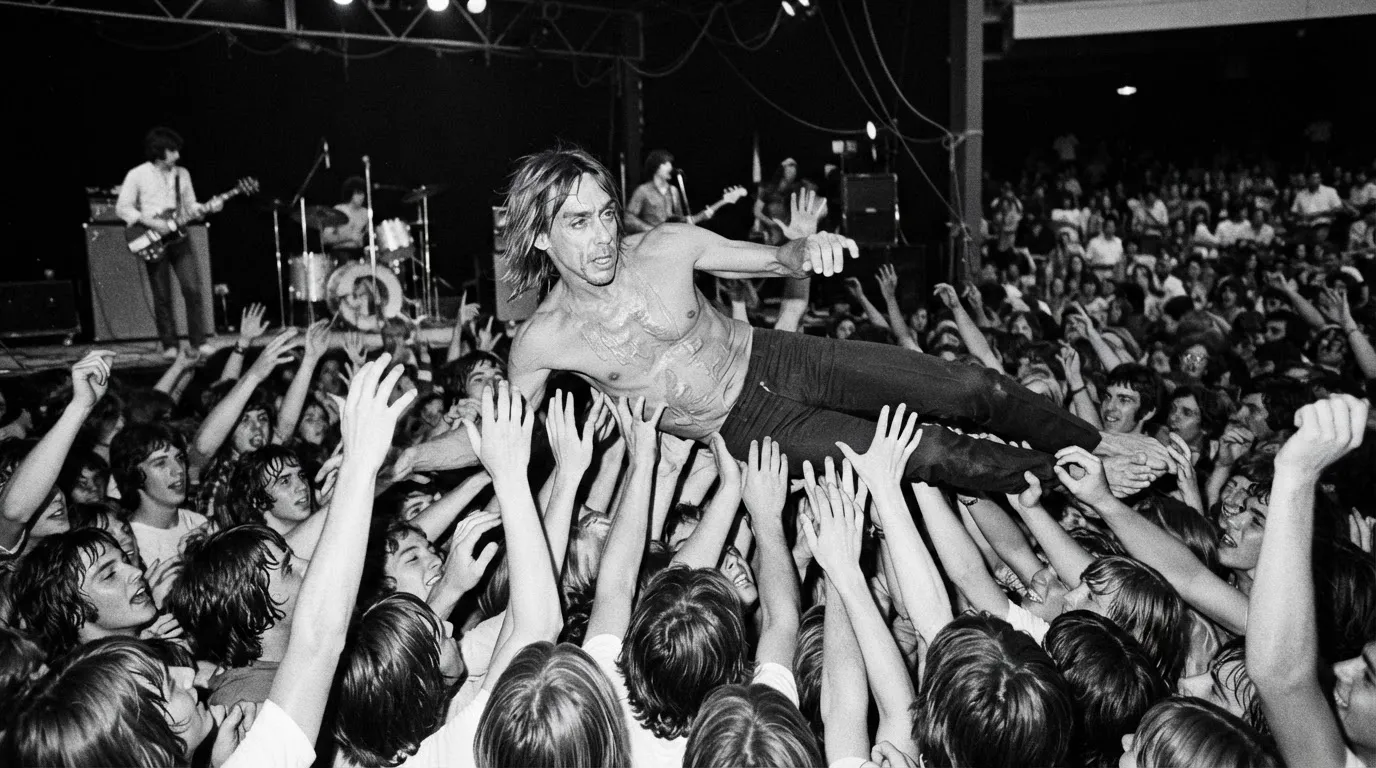
At the Cincinnati Summer Pop Festival in 1970, Iggy Pop did something that was rarely seen at the time. He leapt off the stage and into the audience, and the audience held him up.
Photos from that night became famous partly because of the peanut butter smeared on his chest, which tells you the mood. Nobody had a plan. A singer trusted strangers, and strangers decided to be trustworthy.
The move became a ritual because it worked as an exchange. A performer gave the crowd a chance to touch the show, and the crowd gave him a ride.
Peter Gabriel later became known for his own version, lying back so the audience could pass him along. Over time, venues answered with barricades, front-of-stage security and rules about who could be lifted. The wild improvisation became a recognizable part of live music.
#9 – Slam Dancing at the Cuckoo’s Nest in Costa Mesa
Southern California punk clubs of the late 1970s were small, loud and packed tight. At the Cuckoo’s Nest in Costa Mesa, where bands like Black Flag and Fear played, the front of the room became a place to crash into each other on purpose.
Fans took the bouncing of early punk and added shoulder hits and circling movement. The result was slam dancing, and it spread through the hardcore scene.
At a Glance
- Where: Costa Mesa, California
- When: the late 1970s
- Bands on the bill: Black Flag and Fear, among others
- The unwritten rule: if someone falls, you pick them up
The club itself had a rough reputation with neighbors and authorities, which only added to its legend. Inside, the pit developed its own etiquette, and it needed no signage.
The word “mosh” is often traced to Washington, D.C., hardcore, and it later crossed into metal. Venues learned to live with it by reinforcing barriers and adding staff near the front.
#8 – Demanding Encores in 18th-Century London Opera Houses
The encore is older than electric guitars by about two centuries. In 18th-century London opera houses, audiences shouted for favorite arias to be sung again.
The word is French for “again,” which tells you it was a borrowed demand, and it stuck because performers kept answering it. Applause stopped being only a reward and became a request.
Rock crowds inherited the habit and gave it a soundtrack of stomping, clapping and chanting for “one more song.” The fake exit became part of the show. Bands walk off, the lights stay dark, and everyone pretends it’s over.
Bruce Springsteen’s famously long shows helped make multiple encores feel normal, so the return trip is now baked into setlists. Venues learned to plan curfews around a custom that began as audience impatience to hear a song one more time.
#7 – Stage Diving at Jim Morrison and Iggy Pop Shows
Crowd surfing goes from the stage into the crowd, but a stage dive starts with someone climbing up. Jim Morrison is often cited as an early example, and Iggy Pop turned the move into a signature.
The appeal was simple. The stage was a platform, but it was also a wall, and jumping from it erased the wall for a few seconds.
Quick Compare
- Stage dive: a leap from the stage edge, and the thrill is the drop.
- Crowd surf: a body passed hand over hand, and the thrill is the ride.
- Pogo: feet barely leave the floor, and the thrill is the shared bounce.
It spread in punk and metal scenes, where fans wanted a physical way to match the noise. Often the performer didn’t even have to invite it. A fan would clamber up, wave, and launch.
Venues responded the way they usually do, with taller stages, more security and clear rules about who belongs where. Many still treat the stage edge as a line, but the line exists because fans spent decades jumping over it first.
#6 – Headbanging at Led Zeppelin’s Boston Tea Party Shows
Headbanging has a surprisingly specific origin story. Many accounts point to Led Zeppelin’s late-1960s shows, including the Boston Tea Party, where fans were reported banging their heads against the stage in time with the heavy riffs.
It was the physical version of an idea the band’s music already carried. Some music was meant to be felt in the skull.
Metal bands that followed, from Black Sabbath to later heavy acts, built whole audiences around the motion. Long hair swinging in unison became part of the genre’s visual identity.
Venues didn’t need a policy for most of it. A few barriers and a bit more space near the front were usually enough. What began as a fan’s way to show total surrender to a riff became one of the best-known gestures in rock.
#5 – Trading Friendship Bracelets at Taylor Swift’s Eras Tour
When Taylor Swift sang about making friendship bracelets in “You’re On Your Own, Kid,” fans took it as an assignment. By the time the Eras Tour began in 2023, they were stringing beads into song titles, lyrics and inside jokes.
The trade happened everywhere. Fans swapped in parking areas, in lines, at seats and on concourses, handing a stranger a bracelet and receiving one in return.
Fast Facts
- The song: “You’re On Your Own, Kid,” from the 2022 album Midnights
- The tour: the Eras Tour opened in March 2023 in Glendale, Arizona
- The custom: swap a bracelet, keep a bracelet
- The currency: beads spelling out lyrics, titles and in-jokes
Fans coordinated online before shows, so the custom arrived already organized. People showed up with arms stacked with beads, and the bracelets became a way to start a conversation with someone they’d never met.
Stadiums didn’t have to invent a rule, because the objects were small and hard to object to. What the tour gained was a second show in the crowd, with its own currency of handmade gifts.
#4 – Slogan Events and Light Sticks at K-Pop Concerts
At a K-pop concert, the audience often has a script. Fans learn chants that fit into gaps in the lyrics, and they shout members’ names on cue.
Then there are slogan events. Fan clubs prepare banners or signs ahead of time and organize everyone to raise them during a particular song, often as a surprise for the group. The message is meant for the performers, and the crowd has to coordinate to deliver it.
Light sticks add another layer. Fan groups have their own colors and designs, and BTS’s Army Bomb is a well-known example of a stick that can sync with the show’s lighting.
Venues have to make room for all of it. Nobody hands out the slogan banners or writes the chants, but arenas know the crowd will arrive with them. Fans turned the audience into a coordinated piece of the production.
#3 – Pogo Dancing at the Sex Pistols’ 100 Club Shows
Before the mosh pit, punk had the pogo. One widely told story credits Sid Vicious, then a Sex Pistols fan, with starting it at the 100 Club in London in 1976 by jumping straight up and down.
Some versions say he did it to see the stage over the crowd. Others just say it matched the music. Either way, it caught on because it was easy to copy and worked in a room with no space to move.
The pogo suited small clubs. You could bounce in place without needing an inch of extra room, and a roomful of people doing it created a visible wave.
It also set up what came next. As punk crossed the Atlantic, jumping turned into shoving, and the pogo’s descendants took over the front of the stage. Clubs largely tolerated it because it kept the energy high.
#2 – Phone Flashlight Seas During Arena Ballads
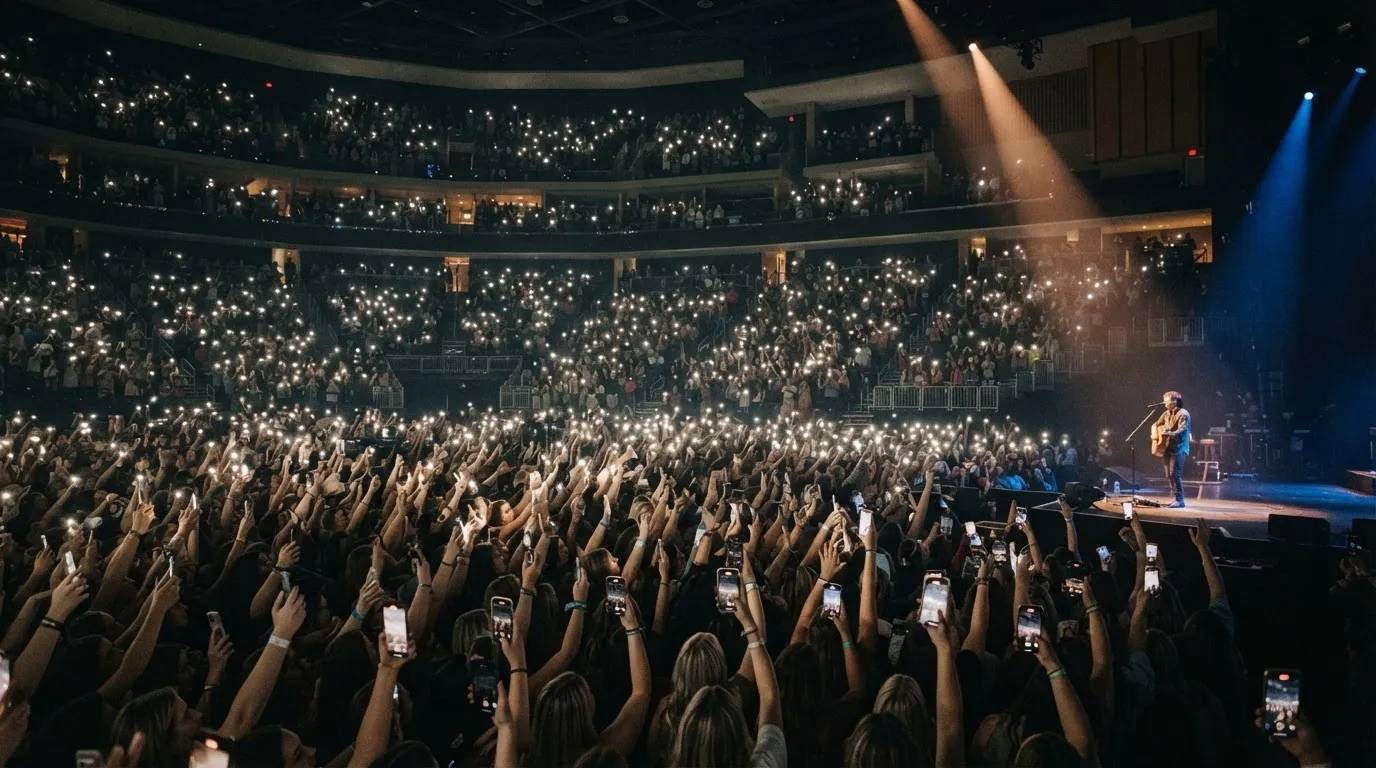
For decades, the quiet moment in a concert belonged to the lighter. Then phones arrived, and every screen turned into a tiny glowing candle.
Once phones had built-in flashlights, the ritual changed quickly. Fans no longer needed a flame, just a thumb and a good moment. The slow song became a cue to lift the phone and sway.
Some fans now coordinate it in advance, posting plans for specific songs. The artist’s view from the stage is the real prize, a dark room suddenly filled with a sea of stars.
Venues were happy to swap flames for flashlights. The custom is a safer replacement for the old lighter moment, and it carries the same message that Dylan’s match-lighters sent: this song matters, and we’re all in it together.
#1 – Taping Shows and Parking Lot Villages at Grateful Dead Concerts
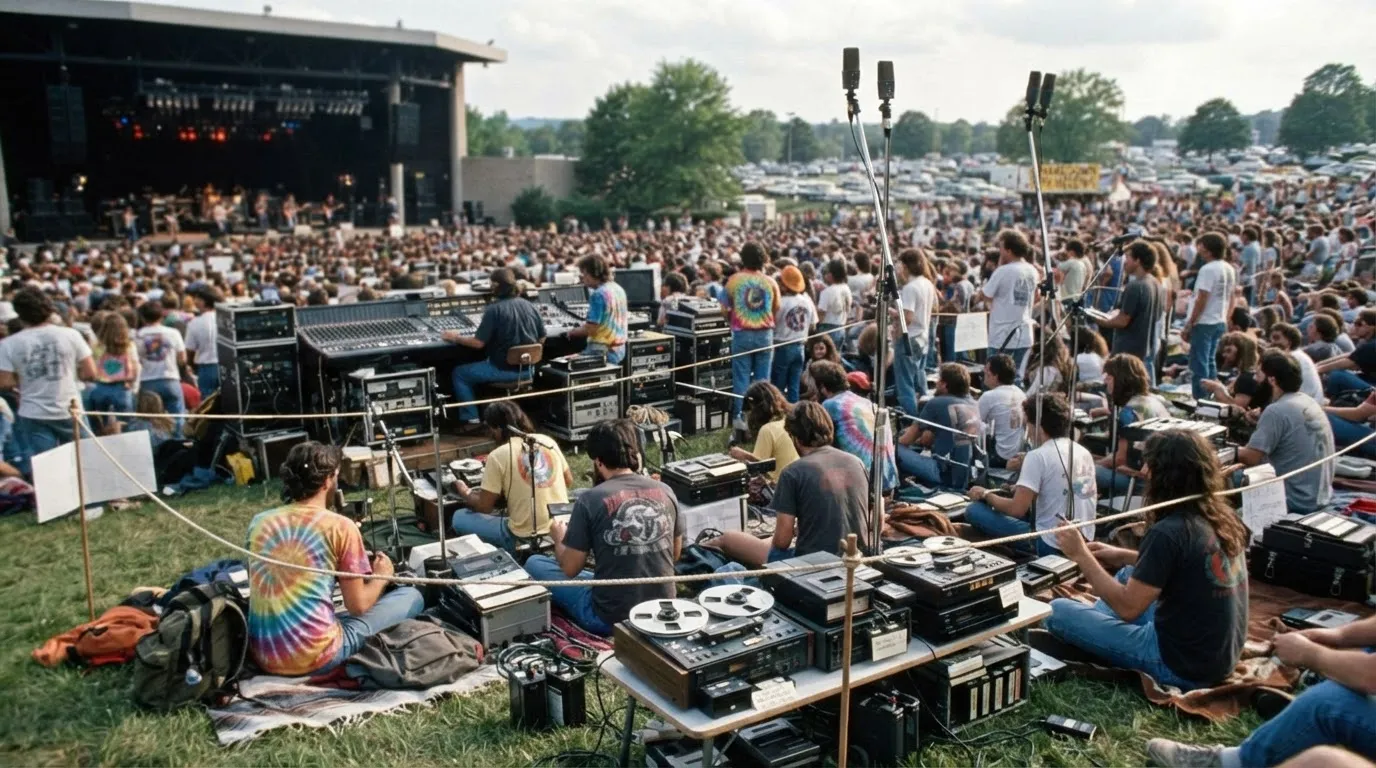
Most bands spent decades fighting people who recorded their shows. The Grateful Dead’s fans did it anyway, and eventually the band blinked.
Deadheads had been taping concerts and trading copies for years. In 1984, the band officially allowed it and set aside a taper section, where fans could set up microphones behind the soundboard. Fans had turned a rule-breaking habit into an accepted part of the show.
Why It Stands Out
- The band moved from tolerating tapers to giving them a designated spot in 1984.
- Fans traded recordings with one another, building an archive of their own.
- The parking lot scene grew into a traveling community outside the venue.
- Shakedown Street took its name from a 1978 Dead album.
The other tradition happened outside the building. Parking lots filled with vendors, music and traveling fans, and one stretch became known as Shakedown Street.
Together, they made a concert into something bigger than two hours inside a hall. The fans built the archive and the village around the band, and the band, rather than fighting them, gave both a place.
CEO-Co-Founder